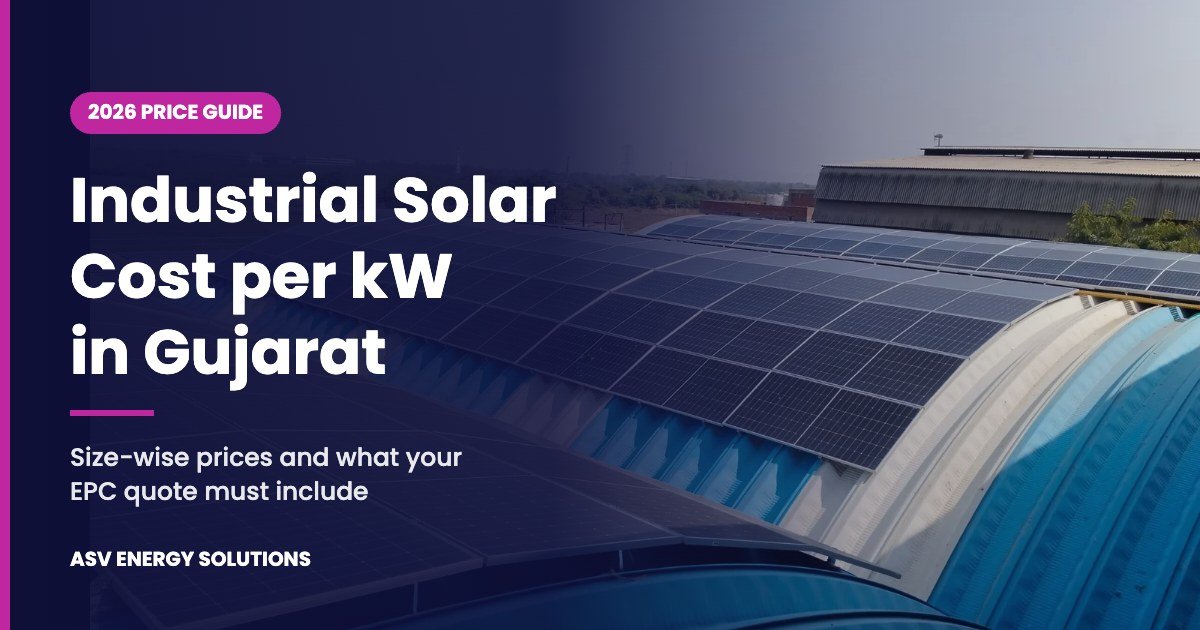
Quick answer: In 2026, industrial rooftop solar in Gujarat typically costs ₹40,000–48,000 per kW for plants of 100 kW and above. Smaller 25–50 kW plants cost more per kW, around ₹42,000–55,000. MW-scale rooftops can come down to ₹35,000–42,000 per kW. The final price depends on roof condition, electrical integration and equipment specifications.
Most factory owners in Gujarat start their solar enquiry with one question: what is the cost per kW?
It is the right place to start, but it is not where the comparison should end. Two EPC companies can quote the same 100 kW plant at different prices because their quotes cover different things. One may include electrical protection, monitoring and DISCOM approvals. The other may list them as extras.
This guide covers indicative costs by plant size, what drives the price, what every EPC quote should include, and how to estimate savings and payback for your factory.
Industrial Solar Cost in Gujarat by Plant Size
Per-kW cost falls as plant size grows. Engineering, mobilisation, approvals and inverter costs are spread over more capacity.
| Plant capacity | Indicative cost per kW | Indicative total cost |
|---|---|---|
| 25 kW | ₹45,000–55,000 | ₹11.25–13.75 lakh |
| 50 kW | ₹42,000–50,000 | ₹21–25 lakh |
| 100 kW | ₹40,000–48,000 | ₹40–48 lakh |
| 200 kW | ₹38,000–45,000 | ₹76–90 lakh |
| 500 kW | ₹36,000–42,000 | ₹1.8–2.1 crore |
| 1 MW | ₹35,000–42,000 | ₹3.5–4.2 crore |
These are indicative 2026 ranges for grid-connected rooftop plants on a structurally sound roof. They are not an ASV Energy Solutions quotation. Ask whether a quote is inclusive or exclusive of GST, because this alone can shift the comparison.
100 kW solar plant cost in Gujarat
A 100 kW industrial rooftop plant usually costs ₹40–48 lakh. It needs roughly 8,000–10,000 sq ft of shadow-free roof and can generate around 1,40,000–1,60,000 units a year in Gujarat conditions.
500 kW and 1 MW rooftop solar cost
At 500 kW and above, per-kW pricing improves noticeably. A 1 MW rooftop plant usually lands between ₹3.5 and ₹4.2 crore. Plants of this size often need HT-side integration, which should be costed separately in the quote.
Why Two Factories Get Different Quotes for the Same Capacity
Take two factories in Gujarat, each planning a 100 kW rooftop plant.
The first has a newer PEB shed, a clear roof and its main LT panel close to the roof. The second has an older sheet roof, several roof levels, ventilators and exhaust units, and a 120-metre cable run to the panel room.
Even with identical panels and inverters, the second factory will pay more. These are the factors that move the price:
- Roof condition: older sheds may need sheet replacement or purlin strengthening before installation.
- Roof layout: multiple levels, skylights and obstructions mean more structure work and less usable area.
- Cable route: longer DC and AC runs add cable, cable trays and labour.
- Connection type: HT-connected factories may need a transformer or HT-side integration work.
- Equipment choice: TOPCon or bifacial modules and premium inverter brands cost more per watt.
- Access and safety: high roofs or running plants may need cranes, lifelines and planned shutdowns.
This is why a serious EPC company will survey the site before confirming a final price. A quote based only on roof area and an electricity bill can miss these costs.
What Your Industrial Solar EPC Quote Must Include
EPC stands for Engineering, Procurement and Construction. One contractor designs the plant, supplies the equipment, installs it and commissions it. Check that your quote spells out each item below.
1. Solar panel specifications
The quote should name the module brand, model, wattage, technology (Mono PERC, TOPCon or bifacial) and warranty terms. Confirm the modules are on the government’s ALMM list.
Two 100 kW quotes are only comparable when the panel specifications match. Different technologies can produce different generation over 25 years.
2. Inverters and electrical equipment
The inverter converts DC power from the panels into AC power your factory can use. The quote should state its brand, model, rating and warranty.
It should also list the ACDB and DCDB panels, surge protection, DC and AC cables, earthing and lightning arresters. Ask whether any changes to your existing LT or HT panel are included.
3. Mounting structure
Most Gujarat factories have metal-sheet or PEB roofs. The structure must match the roof type and be designed for local wind loads.
The contractor should check whether the roof can carry the added load. Any roof repair or strengthening should appear as a separate, clearly priced line item.
4. Installation and commissioning
The quote should cover material transport, installation, electrical connections, testing and commissioning. Ask about cranes, scaffolding and safety arrangements.
If your plant must keep running, agree the installation schedule and any shutdowns in advance.
5. DISCOM approvals and net metering
Grid-connected plants need an application, technical feasibility approval, metering and inspection by your DISCOM. In Gujarat, that is UGVCL, MGVCL, DGVCL, PGVCL or Torrent Power, depending on your location.
The rules depend on your consumer category, connection type and plant capacity. Before signing, confirm which approval work the EPC company will handle and whether DISCOM and GEDA fees are included.
6. Monitoring and maintenance
Ask whether the quote includes remote monitoring and whether you will get access to generation data.
Also confirm who handles maintenance. Who investigates a drop in generation? Is panel cleaning included? How are inverter warranty claims handled? These points matter more over 25 years than a small difference in upfront price.
7. Commercial terms
Check GST treatment, the payment schedule, the project timeline, the performance guarantee (if any) and the list of exclusions. A clear exclusions list is a sign of an honest quote.
Is the Lowest Solar EPC Quote the Best Option?
Not always. A lower quote is only cheaper if it covers the same scope.
Say Contractor A quotes ₹40 lakh for a 100 kW plant and Contractor B quotes ₹44 lakh. Before choosing A, compare both quotes line by line:
- Same module brand, wattage and technology?
- Same inverter brand and rating?
- Same mounting structure design and material?
- Electrical protection, earthing and cabling included in both?
- DISCOM approvals and fees handled by both?
- Same warranty, monitoring and maintenance terms?
- Both quotes inclusive (or both exclusive) of GST?
If Contractor A has left out approvals, roof work or monitoring, the ₹4 lakh gap can disappear once those are added. A higher quote is not automatically better either. The practical approach is to compare on equal scope and ask each contractor to explain the differences.
Savings and Payback for an Industrial Solar Plant
A well-sized industrial plant in Gujarat typically pays back in 2.5 to 4.5 years. Here is an illustrative calculation for a 100 kW plant.
In Gujarat conditions, a 100 kW rooftop plant can generate around 1,50,000 units a year. Assume the factory uses 90% of this power during working hours and its avoided grid cost is ₹8 per unit:
1,50,000 units × 90% × ₹8 = ₹10,80,000 saved per year
At a project cost of ₹40–48 lakh, simple payback works out to roughly 3.7–4.4 years. After that, the plant keeps producing power for the rest of its 25-year life, with modest maintenance costs and a gradual decline in output.
This is an example, not a guaranteed return. Actual savings depend on generation, your tariff, how much power is used on-site versus exported, and maintenance.
To see the plant size, cost and payback for your own electricity bill, use our solar savings calculator.
Payback is shorter when the tariff is higher and nearly all the power is used on site. On ASV’s recent industrial projects, such as the 1,250 kWp plant at Chamunda Plastic Pvt Ltd in Kheda, payback works out to about 2.5 years.
Accelerated depreciation
Unlike homes, factories and businesses can claim accelerated depreciation on solar plants under income tax rules. For a profitable company, this tax benefit can shorten the effective payback further. Confirm the current rate and eligibility with your chartered accountant.
Note that the PM Surya Ghar subsidy applies to residential homes only. Industrial plants should be evaluated without any central subsidy.
How to Choose the Right Solar Capacity for Your Factory
The right capacity matches your daytime consumption, not your roof size.
Filling every square foot of roof is tempting. But if the plant produces more than the factory uses, the extra units are exported. Their value depends on your DISCOM’s rules and is usually lower than the cost of grid power you avoid.
Start with these inputs:
- Your last 12 months of electricity bills
- Working hours and shifts (day-only, or 24-hour operation)
- Sanctioned load and connection type (LT or HT)
- Planned expansion, new machines or extra shifts
A plant running heavy machinery all day can absorb far more solar than a warehouse with light daytime load. A site-specific proposal gives a better answer than any standard per-kW rate.
Industrial Solar Projects by ASV Energy Solutions
ASV Energy Solutions is a Gandhinagar-based solar EPC company working with manufacturers across Gujarat. Our commercial and industrial solar EPC work covers design, supply, installation and approvals. Recent industrial projects include:
- Chamunda Plastic Pvt Ltd, Kheda: a 1,250 kWp rooftop solar plant generating about 20,25,000 units a year
- Ornet Transformers Pvt Ltd, Kadi-Kalol: 1,700 kWp across three factory units
Specifications and results for these and other plants are on our solar projects page.
Industrial Solar EPC in Ahmedabad, Gandhinagar and Across Gujarat
We work with factories in industrial areas such as Vatva, Naroda, Odhav, Sanand, Changodar, Gandhinagar and Mehsana. Each area has different roof types, load patterns and DISCOM processes, so every project starts with a site visit.
Get an Industrial Solar EPC Quote from ASV
To get a project-specific quote, share three things with our team:
- Your factory location
- Your last 12 months of electricity bills
- Approximate shadow-free roof area
We will review your consumption, visit the site, and send a quote that lists the equipment, scope and exclusions clearly, so you can compare it fairly with others.
Frequently Asked Questions
What is the cost of industrial solar per kW in Gujarat?
In 2026, industrial rooftop solar in Gujarat typically costs ₹40,000–48,000 per kW for 100 kW and larger plants. Smaller 25–50 kW plants cost around ₹42,000–55,000 per kW. Roof condition, equipment and electrical work affect the final price.
How much does a 100 kW solar plant cost in Gujarat?
A 100 kW industrial rooftop plant usually costs ₹40–48 lakh. It can generate around 1,50,000 units a year in Gujarat conditions.
What is the payback period for industrial solar in Gujarat?
A well-sized industrial plant typically pays back in 2.5–4.5 years, depending on your tariff and how much of the power is used on site. Accelerated depreciation can shorten this further for profitable businesses.
Is there a subsidy for industrial solar in Gujarat?
The PM Surya Ghar subsidy is only for residential homes. Factories and businesses can instead claim accelerated depreciation under income tax rules. Check the current rate with your CA.
What should a solar EPC quote include?
A complete quote lists panel and inverter specifications, the mounting structure, electrical protection and cabling, installation and commissioning, DISCOM approvals, monitoring, maintenance and warranties. It should also state GST treatment and a clear list of exclusions.
Can solar panels be installed on a PEB factory shed?
Yes, if the roof is structurally sound and the mounting system is designed for the roof type and wind load. A structural check should be done before installation.