Quick answer: A 3 kW on-grid rooftop solar system in Gujarat costs about ₹1.50–1.71 lakh installed with DCR panels (indicative, November 2026). The PM Surya Ghar subsidy of ₹78,000 brings your cost to about ₹72,000–93,000. It makes around 360 units a month and usually pays back in 2.5–3 years.
3 kW is the most popular home solar size in Gujarat, and for good reason: it’s the size at which the central subsidy reaches its maximum of ₹78,000. But in October 2026 Gujarat added a new state top-up subsidy for systems up to 2.18 kW, so for some homes a smaller plant is now the better deal. This guide gives you the full 3 kW price, the cost after subsidy, what’s inside the quote, the savings on a real Gujarat bill, and a straight comparison with the 2.18 kW option.
We’re ASV Energy Solutions, a solar EPC company in Koba, Gandhinagar. The prices below are what a properly built system costs in Gujarat today, not the cheapest number you can find online.
3 kW solar system price in Gujarat at a glance
| Item | 3 kW on-grid (DCR panels) |
|---|---|
| Installed price before subsidy | ₹1,50,000 – ₹1,71,000 |
| Price per kW | ₹50,000 – ₹57,000 |
| PM Surya Ghar central subsidy | ₹78,000 |
| Gujarat state top-up | Not available (only up to 2.18 kW) |
| Your cost after subsidy | ₹72,000 – ₹93,000 |
| Generation | About 360 units a month (4,300 a year) |
| Roof area needed | About 250–300 sq ft, shadow-free |
| Payback | About 2.5–3 years for a home using 400 units a month |
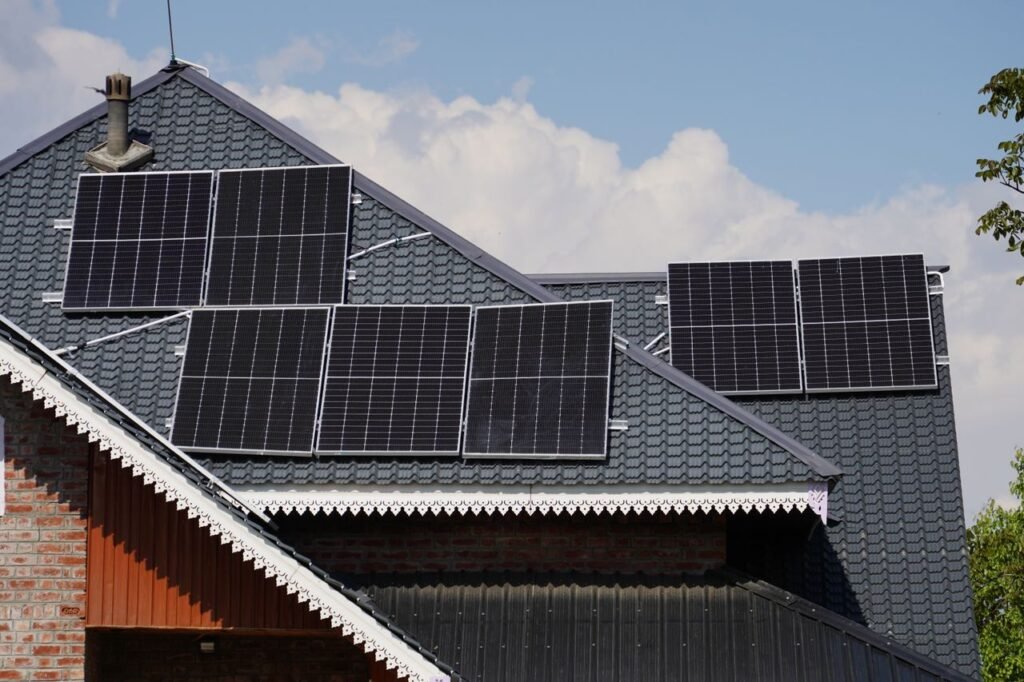
A 3 kW plant uses five or six DCR panels (for example 5 × 600 Wp or 6 × 550 Wp TOPCon modules) and a 3 kW single-phase on-grid inverter. It works on a normal single-phase home connection. If your sanctioned load is below 3 kW, the DISCOM may ask you to raise it first; we check this before filing.
3 kW price after subsidy: how the ₹78,000 is worked out
Under PM Surya Ghar: Muft Bijli Yojana, the central subsidy (CFA) is ₹30,000 a kW for the first 2 kW and ₹18,000 for the third kW. That adds up to ₹78,000, and it stops there: a 4 kW or 5 kW home system gets the same ₹78,000. So 3 kW is where the subsidy gives you the most per rupee spent.
| Capacity | Central subsidy |
|---|---|
| 1st kW | ₹30,000 |
| 2nd kW | ₹30,000 |
| 3rd kW | ₹18,000 |
| Total for 3 kW | ₹78,000 |
To get it, the panels must be DCR (made in India with Indian cells), the vendor must be registered on the portal for your DISCOM, and the connection must be in your name with no earlier rooftop subsidy taken. You pay the vendor the full price first; the subsidy reaches your bank account after the DISCOM fits the net meter and approves the plant, usually within 15–30 days. Full details are in our Gujarat solar subsidy guide.
What’s inside a 3 kW quote: itemised cost
| Component | Indicative cost |
|---|---|
| DCR TOPCon panels, 3,000 Wp at about ₹27/W | ₹81,000 |
| 3 kW on-grid inverter | ₹28,000 |
| Mounting structure (galvanised, elevated) | ₹24,000 |
| DC and AC cables, ACDB/DCDB, earthing, lightning arrester | ₹16,000 |
| Installation and commissioning | ₹7,000 |
| Net meter connectivity charge and paperwork | ₹3,000 |
| Total before subsidy | ₹1,59,000 |
| Less central subsidy | − ₹78,000 |
| Your cost | ₹81,000 |
Where quotes differ most is the structure and the BOS (cables, earthing, protection). A cheap quote often saves on these: thin structure that rusts in five years, undersized cable, a single earth pit. Ask every vendor to write the panel make and wattage, inverter make, structure material and thickness, and number of earth pits in the quote. Since September 2025, GST on solar panels and systems is 5%, so a turnkey 3 kW system carries an effective GST of roughly 9%.
How much will a 3 kW system save on your bill?
In Gujarat a well-installed 3 kW plant makes about 4 units per kW a day, roughly 360 units a month or 4,300 a year. More in March–May, less in the monsoon. Here’s what that does to a UGVCL, DGVCL, MGVCL or PGVCL home bill at different monthly usage:
| Monthly use | Bill before solar | Bill after 3 kW | Monthly benefit |
|---|---|---|---|
| 250 units | ₹1,588 | ₹25 + ₹248 surplus credit | ₹1,810 |
| 300 units | ₹1,970 | ₹25 + ₹135 surplus credit | ₹2,080 |
| 350 units | ₹2,352 | ₹25 | ₹2,350 |
| 400 units | ₹2,735 | ₹245 | ₹2,490 |
| 500 units | ₹3,500 | ₹862 | ₹2,638 |
For a home using 400 units a month, the benefit is about ₹2,490 a month or ₹29,900 a year. On a cost of ₹72,000–93,000 after subsidy, that’s a payback of about 2.4–3.1 years, and the panels carry a 25-year performance warranty. Notice the 250-unit row: that home exports 110 units a month at only ₹2.25 each. It is oversized for 3 kW, which leads to the question below.
Under GERC’s new net metering rules, notified at the end of October 2026, homes still get full set-off and ₹2.25 for surplus units, so these numbers hold. Our net metering guide for Gujarat explains the rules DISCOM by DISCOM.
3 kW or 2.18 kW with the new Gujarat state subsidy?
In October 2026 the Gujarat government announced a state top-up on PM Surya Ghar for home systems with total capacity up to 2.18 kWp (SolarQuarter, 27 October 2026). After the central subsidy, the state pays the balance of the benchmark cost, and you pay only 10% of the benchmark (5% for SC/ST households). The benchmark is ₹50,000 a kW for the first 2 kW. Payment goes by DBT through your DISCOM, with GUVNL as the nodal agency.
A 3 kW system is above the 2.18 kWp limit, so it gets only the central ₹78,000. That makes 2.18 kW a serious alternative for smaller homes:
| Item | 2.18 kW with state top-up | 3 kW |
|---|---|---|
| Central subsidy | ₹63,240 | ₹78,000 |
| State top-up | Yes | No |
| Your share (general category) | About ₹10,810 (10% of benchmark)* | ₹72,000 – ₹93,000 |
| Generation per month | About 260 units | About 360 units |
| Benefit at 250 units use | About ₹1,590 | About ₹1,810 |
| Benefit at 400 units use | About ₹1,890 | About ₹2,490 |
| Can add capacity later? | Not for 3 years | Yes, with DISCOM approval |
Our rule of thumb:
- Using under about 300 units a month? Choose 2.18 kW with the state top-up. You pay a fraction of the cost and a 3 kW plant would mostly export surplus at ₹2.25.
- Using 350 units or more? 3 kW saves about ₹600 a month more at 400 units, and more as usage rises. It costs more upfront, but over 25 years it saves you more, and you can grow it later.
- Planning an AC, EV or more family members soon? Lean towards 3 kW. With the top-up, you can’t add panels for three years.
The state scheme applies to systems commissioned on or after 22 October 2026, and the details of how DISCOMs process it are still being rolled out. We’ll update this page as the procedure is published.
3 kW price by system type
| Type | Indicative price (3 kW) | Subsidy | Best for |
|---|---|---|---|
| On-grid (net metered) | ₹1.50 – 1.71 lakh | ₹78,000 | Most Gujarat homes with reliable grid power |
| Hybrid (with battery) | ₹2.5 – 4.5 lakh | Ask before buying; the battery itself is not subsidised | Homes that need backup during cuts |
| Off-grid | ₹2.2 – 2.8 lakh | No | Farmhouses or sites without a grid connection |
For most homes in Gujarat, on-grid is the right choice. Power cuts in cities are rare, and the net meter acts like a free battery: what you export by day is set off against what you use at night.
Paying in instalments: 3 kW solar on EMI
Under PM Surya Ghar, public sector banks offer collateral-free loans for home systems up to 3 kW at around 7% interest. If you take a loan, the subsidy goes to your loan account first. On ₹72,000–93,000 (your cost after subsidy) over five years at 7%, the EMI is about ₹1,430–1,840 a month, less than the ₹2,490 the plant saves on a 400-unit bill. So the system pays its own EMI from day one.
How to get a 3 kW system installed in Gujarat
- Check your last 12 bills and roof. Average monthly use tells you whether 3 kW or 2.18 kW suits you.
- Register on pmsuryaghar.gov.in with your DISCOM and consumer number, and apply for rooftop solar.
- Choose a vendor registered for your DISCOM and agree the design and price in writing.
- The vendor installs the plant (one to two days on site) and uploads the plant details.
- The DISCOM inspects and fits the net meter. The commissioning report is generated.
- Submit your bank details on the portal. The subsidy arrives in your account.
ASV has completed 5,500+ solar installations and 90 MW+ of capacity, and handles every step of the portal and DISCOM paperwork for you. See our solar installation services, compare all sizes from 1 kW to 10 kW in our solar panel price list for Gujarat, or size your plant in 30 seconds with our solar savings calculator. Living in Ahmedabad? See our solar company in Ahmedabad page.
3 kW સોલાર સિસ્ટમની કિંમત (ટૂંકમાં)
- 3 kW ઓન-ગ્રીડ સિસ્ટમ (DCR પેનલ): આશરે ₹1.50–1.71 લાખ (નવેમ્બર 2026, અંદાજિત).
- PM સૂર્ય ઘર સબસિડી ₹78,000 પછી તમારો ખર્ચ આશરે ₹72,000–93,000.
- મહિને આશરે 360 યુનિટ વીજળી; 400 યુનિટ વપરાશ પર મહિને આશરે ₹2,490 બચત.
- મહિને 300 યુનિટથી ઓછો વપરાશ હોય તો 2.18 kW પર ગુજરાત સરકારની વધારાની સબસિડી વધુ ફાયદાકારક છે.
Frequently asked questions
What is the price of a 3 kW solar system in Gujarat?
A 3 kW on-grid rooftop system with DCR panels costs about ₹1.50–1.71 lakh installed in Gujarat (indicative, November 2026). After the ₹78,000 PM Surya Ghar subsidy, you pay about ₹72,000–93,000.
How much subsidy is available on a 3 kW solar system in Gujarat?
The central PM Surya Ghar subsidy for 3 kW is ₹78,000: ₹30,000 a kW for the first 2 kW and ₹18,000 for the third kW. The new Gujarat state top-up applies only to systems up to 2.18 kWp, so a 3 kW system gets the central subsidy only.
Is the Gujarat state solar subsidy available for 3 kW?
No. The state top-up announced in October 2026 is for home systems with total capacity up to 2.18 kWp. Above that, including 3 kW, only the central ₹78,000 applies.
How many units does a 3 kW solar system generate in Gujarat?
About 4 units per kW a day, so roughly 360 units a month or 4,300 units a year. Output is higher in March–May and lower in the monsoon.
Is 3 kW enough for my home?
A 3 kW system suits a home using about 350–450 units a month, typically with two or three ACs used part of the year. If you use under 300 units a month, a 2.18 kW system with the state top-up is usually better value.
How much roof space does a 3 kW solar system need?
About 250–300 sq ft of shadow-free roof for five or six panels. An elevated structure lets you keep using the roof below the panels.
What is the payback period of a 3 kW solar system in Gujarat?
For a home using 400 units a month, a 3 kW plant saves about ₹2,490 a month. On a cost of ₹72,000–93,000 after subsidy, payback is about 2.4–3.1 years.
Can I get a loan for a 3 kW solar system?
Yes. Under PM Surya Ghar, public sector banks offer collateral-free loans for systems up to 3 kW at around 7% interest. The EMI over five years is usually lower than the monthly bill saving.
Do I need a battery with a 3 kW solar system?
Not for an on-grid system. The net meter sets off the units you export by day against what you use at night. Add a battery (hybrid system) only if you need backup during power cuts.
How long does it take to install a 3 kW solar system and get the subsidy?
Installation takes one to two days on site. The DISCOM then inspects and fits the net meter, usually within a few weeks, and the subsidy reaches your bank account typically 15–30 days after approval.
Sources
- MNRE, Operational guidelines for PM Surya Ghar: Muft Bijli Yojana (June 2024): CFA rates, DCR, vendor CMC.
- PIB, PM Surya Ghar: Muft Bijli Yojana (13 March 2025): subsidy, loan and process.
- Business Today, Claim up to ₹78,000 under PM Surya Ghar scheme (28 July 2026).
- SolarQuarter, Gujarat offers additional subsidy for rooftop solar systems up to 2.18 kWp (27 October 2026).
- Mercom India, Gujarat announces top-up subsidy for rooftop solar (26 October 2026).
- SolarQuarter, GERC notifies 2026 Distributed Renewable Energy Regulations (2 November 2026).
- GERC, Tariff schedule of DGVCL, MGVCL, PGVCL and UGVCL, effective 1 April 2026.
- pv magazine India, GST on solar cells and modules cut to 5% (4 September 2025).
Get an exact 3 kW price for your roof
Send us your last electricity bill and a photo of your roof. We’ll tell you whether 3 kW or 2.18 kW suits you, what it costs after subsidy, and what it will save. Call or WhatsApp +91 96626 63069.