
Quick answer: Size a factory solar plant on the units you use while the sun is up, not on the rupee bill. In Gujarat, 1 kW makes about 125 units a month, so plant size in kW ≈ monthly daytime units ÷ 125. A one-shift factory with a ₹1 lakh bill needs about 85 kW, subject to roof and DISCOM limits.
“Our bill is ₹2 lakh a month. How big a plant do we need?” We hear that question almost every week, and the honest answer is: it depends on when you use the power, not just how much.
Two factories with the same ₹2 lakh bill can need very different plants. One runs a single day shift and could use a 170 kW plant almost fully. The other runs round the clock and would waste a lot of a 170 kW plant’s output. This guide walks you through sizing solar for factories in Gujarat from your own bill, step by step, so the number you take to an EPC is one you can defend.
We’re ASV Energy Solutions, a solar EPC company in Koba, Gandhinagar. Sizing is the first thing we do on every factory visit, and getting it wrong in either direction costs money.
Want us to size it from your bills? Send us 12 months of electricity bills and your shift timings. We work out the right capacity, check your roof and give you a fixed, itemised quote. The site visit is free.
Step 1: Read your bill in units, not rupees
Rupees mislead because they include fixed charges, demand charges, fuel surcharge and duty. Solar replaces units (kWh), so that’s what you size on. Pull out the last 12 months of bills and note:
- Units consumed each month. Average them, because summer and monsoon months can differ a lot.
- Sanctioned load or contract demand, and whether you are on an LT or HT connection.
- Your DISCOM, printed at the top: Torrent Power, UGVCL, MGVCL, DGVCL or PGVCL.
- Time-of-day split. If you have a time-of-day meter, note how your units split across the day.
If you only have rupee figures, divide the bill by your all-in rate per unit. For most Gujarat industry that’s about ₹7.50 to ₹8.50 a unit once demand charges, fuel surcharge and duty are counted.
Step 2: Work out how much you use in solar hours
Solar produces mostly between about 9 am and 5 pm. A unit used in that window saves you the full grid rate. A unit produced when your machines are off goes to the grid under net metering, and the credit for surplus power is far lower than what you pay for a unit from the grid. So the share of your power used in daylight decides your size.
| Shift pattern | Share of units used in solar hours (approx.) |
|---|---|
| One day shift, about 9 am to 6 pm | About 85% |
| Two shifts, about 6 am to 10 pm | About 55% |
| Round the clock, flat load | About 33% |
These come from simple hours. A flat 24-hour load spends about 8 of its 24 hours in solar time, so roughly a third. If you have a time-of-day meter, use your actual numbers instead.
Step 3: Turn daytime units into kW
The sizing rule: plant size (kW) = monthly units used in solar hours ÷ 125.
Why 125? In Gujarat, 1 kW of panels makes about 1,500 units a year, which is about 125 a month on average, or roughly 4 units a day.
Example: a factory using 12,500 units a month on one day shift uses about 85% of that in solar hours, so about 10,600 units. Divide by 125 and you get about 85 kW.
This gives you a starting solar plant size. It already leaves some headroom, because the plant still runs on Sundays and holidays when your load is low, and that output is exported.
Bill to capacity: a quick table
At about ₹8 a unit, here’s roughly what different bills need. These are before the roof and DISCOM limits in the next section.
| Monthly bill | Units a month | 1 shift | 2 shifts | 24×7 |
|---|---|---|---|---|
| ₹50,000 | 6,250 | 43 kW | 28 kW | 17 kW |
| ₹1 lakh | 12,500 | 85 kW | 55 kW | 33 kW |
| ₹2 lakh | 25,000 | 170 kW | 110 kW | 66 kW |
| ₹5 lakh | 62,500 | 425 kW | 275 kW | 165 kW |
| ₹10 lakh | 1,25,000 | 850 kW | 550 kW | 330 kW |
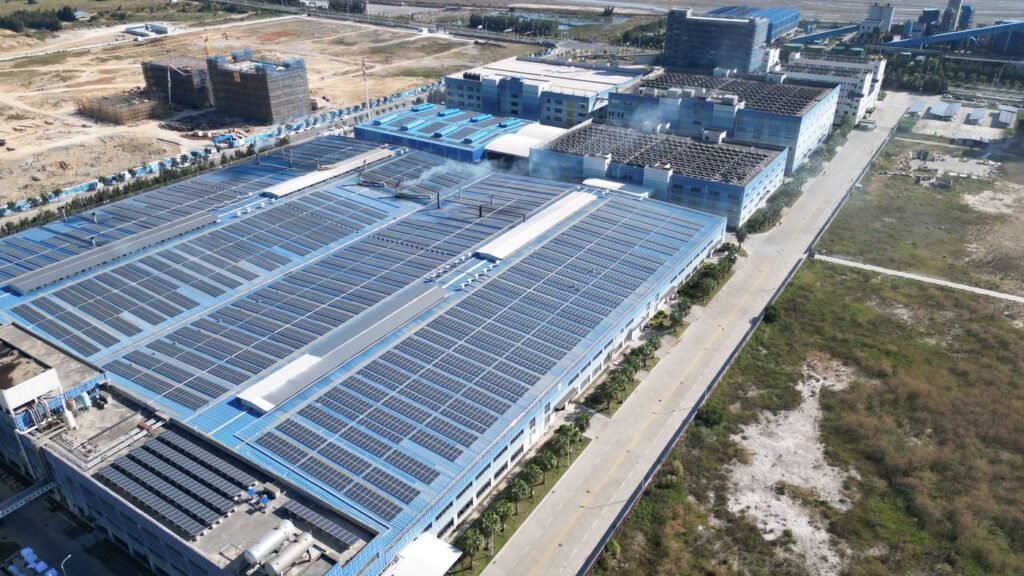
Once you have a size, our industrial solar installation cost per kW guide shows what plants of 50 kW, 100 kW and larger cost in Gujarat. For a quick estimate from your bill, try our solar rooftop calculator.
Worked example: a two-shift unit with a ₹1.6 lakh bill
- The bill. A plastic moulding unit pays about ₹1.6 lakh a month, or about 20,000 units at ₹8. It runs two shifts, roughly 6 am to 10 pm, six days a week.
- Daytime units. About 55% of 20,000 units fall in solar hours, so roughly 11,000 units a month.
- Size. 11,000 ÷ 125 gives about 88 kW, so around 90 kW. With 580–620 W TOPCon panels, that’s about 146–155 panels.
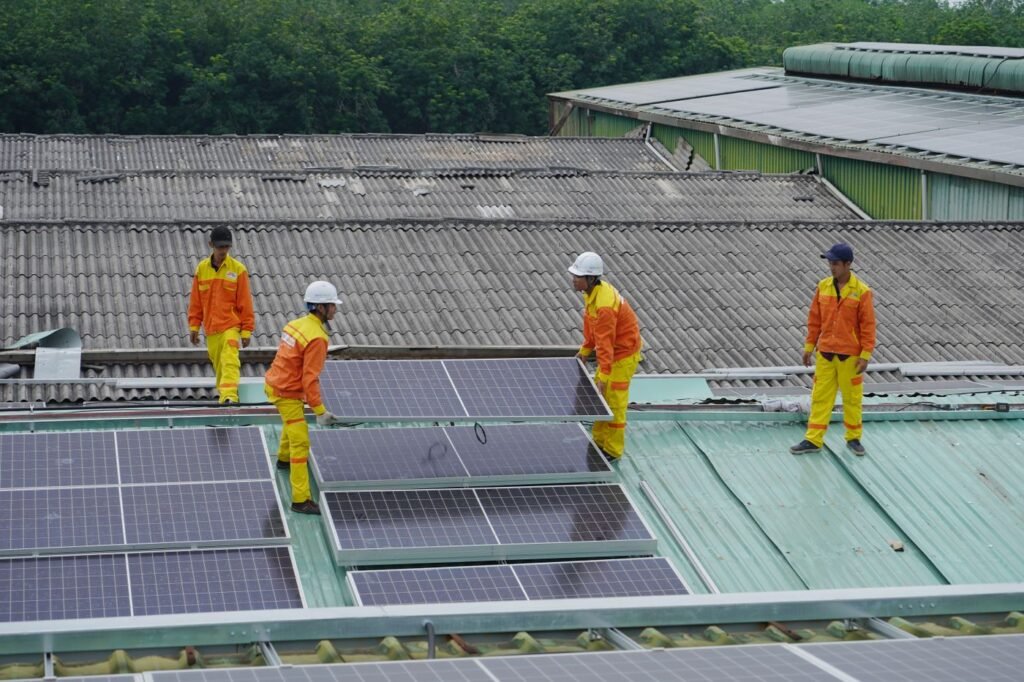
- Roof check. 90 kW needs about 7,200 to 9,000 sq ft of shade-free roof. The shed has about 8,500 sq ft usable after walkways, so 90 kW fits. If it had only 6,000 sq ft, the roof would cap the plant at about 60 to 75 kW.
- Result. A 90 kW plant makes about 1.35 lakh units a year and saves roughly ₹9.4 lakh a year at this unit’s rates (about ₹7 per solar unit, a little below the ₹8 bill rate, because solar doesn’t cut fixed and demand charges and Sunday exports earn less). At about ₹44,000 per kW, that’s around a ₹39.6 lakh plant with a payback of a little over 4 years.
Notice what didn’t decide the size: the ₹1.6 lakh. Sized on rupees alone, someone might have quoted 160 kW, and almost half its output would have gone to the grid at a poor value. Prices are indicative, October 2026.
Three limits that can cap your size
1. Roof space
Plan for about 80 to 100 sq ft of shade-free roof per kW, plus walkways for cleaning and fire access. Turbo ventilators, skylights and water tanks all eat space. The roof also needs enough life left in it, and our factory rooftop solar guide explains the roof check we do before quoting. For industrial rooftop solar, the roof is often the real limit, not the bill. If the roof can’t take the size you need, a ground mounted solar plant on land elsewhere can supply the rest.
2. The capacity your DISCOM approves
Your DISCOM approves a specific capacity after a technical feasibility check, and that’s the number you’re allowed to run. Running more than the approved capacity is treated as unauthorised, and in September 2026 GERC upheld a penalty on a consumer who had installed rooftop capacity beyond the limit allowed. Apply for the size you actually need, and apply again before you expand.
3. Your transformer and feeder
Under the GERC net metering regulations (as amended), the DISCOM’s feasibility check looks at your load, the transformer and the feeder. If the network needs strengthening, there may be a cost, so ask about it early, especially if your transformer already runs close to full.
What the 2026-27 tariff changes for sizing
From 1 April 2026, GERC kept scheduled tariff rates unchanged for both the state DISCOMs and Torrent Power, but it changed the time-of-use rules (GERC press note, March 2026):
- UGVCL, MGVCL, DGVCL, PGVCL: the 60 paise a unit time-of-use discount now runs from 11 am to 5 pm (earlier 11 am to 3 pm), and more categories, including HT and LTMD consumers, now get it.
- Torrent Power (Ahmedabad, Gandhinagar, Surat): time-of-use charges for HT consumers now apply from 6 am to 8 am and 5 pm to 11 pm. The old night concession was replaced with a solar hours rebate of 30 paise a unit between 11 am and 3 pm for HTMD I and HTMD II consumers.
What that means for you: grid power at midday is now a little cheaper for many industrial consumers, so each solar unit used in those hours saves 30 to 60 paise less. It doesn’t change the sizing rule, and solar still pays back well. But if your evening load is heavy, solar won’t touch the evening time-of-use charge, so don’t expect it to. Check your own tariff category before you size.
Sizing mistakes we see most
- Sizing on the rupee bill instead of units.
- Sizing on sanctioned load. A 200 kW sanctioned load says nothing about how much you use at noon.
- Ignoring night shifts. A round-the-clock unit needs a much smaller plant than its bill suggests.
- Oversizing to “future-proof”. Exported power is worth little, so only size up for expansion that is already certain, and apply for that capacity properly.
- Skipping efficiency. Fixing compressed air leaks or old motors first can lower the load you need to cover.
Want to see how size changes savings and payback? Our industrial solar ROI calculator lets you try your own numbers.
Frequently asked questions
How much solar capacity does my factory need?
Divide the units you use during solar hours each month by 125. In Gujarat, 1 kW makes about 125 units a month. Then check that your roof has 80 to 100 sq ft of shade-free space per kW and that your DISCOM will approve that capacity.
What size solar plant is needed for a ₹1 lakh electricity bill?
At about ₹8 a unit, a ₹1 lakh bill is roughly 12,500 units a month. A one-shift factory would need about 85 kW, a two-shift factory about 55 kW, and a round-the-clock unit about 33 kW.
Should I size solar to my sanctioned load?
No. Sanctioned load is the maximum you are allowed to draw, not what you actually use during the day. Size to your daytime units, then confirm the capacity your DISCOM will approve.
What happens if I install a bigger plant than I need?
The extra output is exported on Sundays and through the day when your load is low. Surplus units earn far less than a unit you use yourself, so payback gets longer. Running above your approved capacity can also attract a penalty.
How much roof area do I need per kW?
About 80 to 100 sq ft of shade-free roof per kW, plus space for walkways. So a 100 kW plant needs roughly 8,000 to 10,000 sq ft.
Can a factory running 24 hours use rooftop solar?
Yes, but with a smaller plant. Only about a third of a round-the-clock load falls in solar hours, so size to that share. The plant will still cut the daytime part of your bill.
How much does a 90 to 100 kW factory solar plant cost?
Around ₹44,000 per kW installed for a plant of this size, so roughly ₹40 to 44 lakh (indicative, October 2026). Payback is usually a little over 4 years for a factory that uses most of the output itself.
How many solar panels does a 90 kW plant need?
With today’s 580–620 W TOPCon panels, about 146 to 155 panels. Older 540–550 W panels would need more panels and more roof space for the same capacity.
Did the 2026-27 tariff change make solar less worth it?
Only slightly. GERC kept tariff rates unchanged but gave a 30 to 60 paise discount on some midday units, so each solar unit used in those hours saves a little less. Factory solar in Gujarat still typically pays back in about 4 years.
What do you need from me to size the plant?
Twelve months of electricity bills, your shift timings, and roof photos or a drawing. ASV then visits the site for free, checks the roof and sends an itemised quote with savings and payback.
Sources
- GERC, press note on FY 2026-27 tariff orders (March 2026): unchanged rates, time-of-use and solar hours changes.
- DeshGujarat, GERC unveils FY 2026-27 power tariff in Gujarat (25 March 2026).
- GERC, Torrent Power tariff schedule, effective 1 April 2026.
- GERC, Net Metering Rooftop Solar PV Grid Interactive Systems (Fourth Amendment) Regulations 2024, further amended in 2025.
- SolarQuarter, GERC approves Fifth Amendment to net metering regulations (10 November 2025).
- SolarQuarter, GERC upholds penalty for unauthorised rooftop solar capacity (21 September 2026).
Get your factory sized properly
Book a free factory solar assessment. We check your bills, shifts and roof, and send an itemised quote for the right capacity with savings, payback and the loan option. Call or WhatsApp +91 96626 63069.