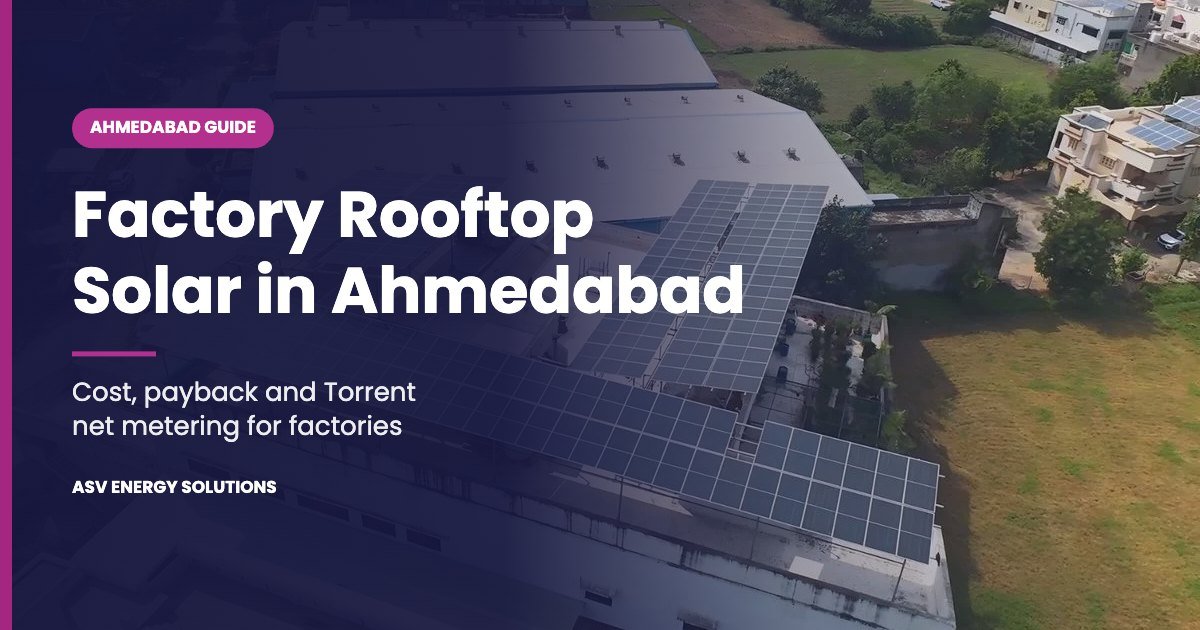
Quick answer: In 2026, a 100 kW rooftop solar plant on a sound factory shed in Ahmedabad typically costs ₹40 to ₹48 lakh, makes around 1.5 lakh units a year and pays back in about 3.5 to 4 years. Before any quote, the roof needs a proper structural check, and Torrent Power or UGVCL has to approve the capacity.
Most factory owners we meet in Ahmedabad already know solar makes sense. The power bill tells them that every month. What they don’t know is the real number. How much will a plant on their own shed cost? Will the roof take it? And how long before Torrent Power or UGVCL lets it run?
This guide answers those three questions for factory rooftop solar in Ahmedabad, with 2026 prices, the actual Gujarat approval steps and a worked example for a 100 kW unit.
We are ASV Energy Solutions, a solar EPC company based in Koba, Gandhinagar, and we install industrial plants across Ahmedabad and the rest of Gujarat. So yes, we have a stake in this. We’ve kept the numbers honest anyway, because a quote that falls apart after the site visit wastes everyone’s time.
What factory rooftop solar costs in Ahmedabad in 2026
For a grid connected plant on a sound roof, most 100 kW to 200 kW factory plants around Ahmedabad come in at about ₹40,000 to ₹48,000 per kW in 2026. Smaller plants cost more per kW, because design, approvals and cabling to the panel room are fixed costs spread over fewer panels. MW-scale roofs come in lower. Our industrial solar cost per kW guide has the full size-wise table and what an EPC quote must include. If you have quotes in hand, compare them on our 12 checks before signing.
| Plant size | Typical 2026 cost | Units per year (approx.) |
|---|---|---|
| 50 kW | ₹21 to ₹25 lakh | 75,000 |
| 100 kW | ₹40 to ₹48 lakh | 1,50,000 |
| 200 kW | ₹76 to ₹90 lakh | 3,00,000 |
The units column assumes about 1,500 units per kW per year, a fair average for Gujarat. A dusty roof that nobody cleans will do worse.
Why 2026 quotes are higher than 2024 quotes
If a neighbour tells you their plant cost far less two years ago, they are probably right. Module prices were unusually low in 2024. Since 1 June 2026, net metering projects have to use modules made with Indian cells listed under ALMM List-II, and those modules cost more than imported-cell panels.
You can see the effect in our own work. Our 100 kWp plant at Vijay & Kishor Engineering in Vatva GIDC, commissioned in 2024, cut the monthly bill from about ₹1,20,000 to ₹30,000 and is on track to pay back in about 2.5 years. The same plant quoted in 2026 would land closer to 3.5 to 4 years at LT tariffs. Units on HT connections, where each solar unit saves more, still pay back faster: our 1,250 kWp plant at Chamunda Plastic, commissioned in April 2026, saves about ₹10 a unit and is on track for about 2.5 years.
What pushes your price up or down?
- Roof type. A metal sheet shed with healthy purlins is the cheapest roof to work on. RCC roofs need raised structures, which means more steel.
- Structure height. If you want the plant raised so the roof below stays usable, you pay for taller columns and stronger foundations.
- Distance to your LT panel or transformer. Long cable runs across a big campus add up fast.
- Panel and inverter brands. Good bifacial panels and a well known inverter cost more than budget options. In our view they usually earn that back.
- Safety and access. Walkways, lifelines and a fixed ladder are not optional on a sheet roof. Some quotes leave them out to look cheaper.
- Monitoring and AMC. Remote monitoring and a multi year maintenance contract change the number too.
Torrent Power or UGVCL: which DISCOM handles your factory?
This matters more than people think. The DISCOM approves your capacity, fits your meter and decides how surplus units are treated. Inside Ahmedabad city, including industrial areas like Vatva, Naroda and Odhav, supply usually comes from Torrent Power. Units on the outskirts, in belts like Changodar, Sanand or Bavla, are often on UGVCL instead. Don’t guess. The name is printed at the top of your electricity bill.
For a sense of the numbers, Torrent Power’s 2026-27 tariff for LT industrial connections (LTMD) charges ₹5.00 per unit as the energy charge above 50 kW of billing demand, before fuel surcharge and electricity duty. On our Vatva plant, each solar unit saves about ₹7.30 once those are added. Solar cuts the energy part of your bill. The fixed demand charge stays.
Both DISCOMs follow the same rulebook, the GERC net metering regulations for rooftop solar. One real difference sits in the 2024 amendment. If your HT connection needs strengthening for the solar plant, state owned DISCOMs charge a fixed rate per kVA, while other licensees can ask you to bear the actual cost of the upgrade. Ask about this early if your transformer is already running close to full.
The roof check we do before any factory solar quote
A solar plant sits on your roof for 25 years. The roof has to last that long, carry the extra weight and hold the panels down through pre monsoon storms. That’s why we don’t quote a factory without climbing up first.
Metal sheet and PEB sheds
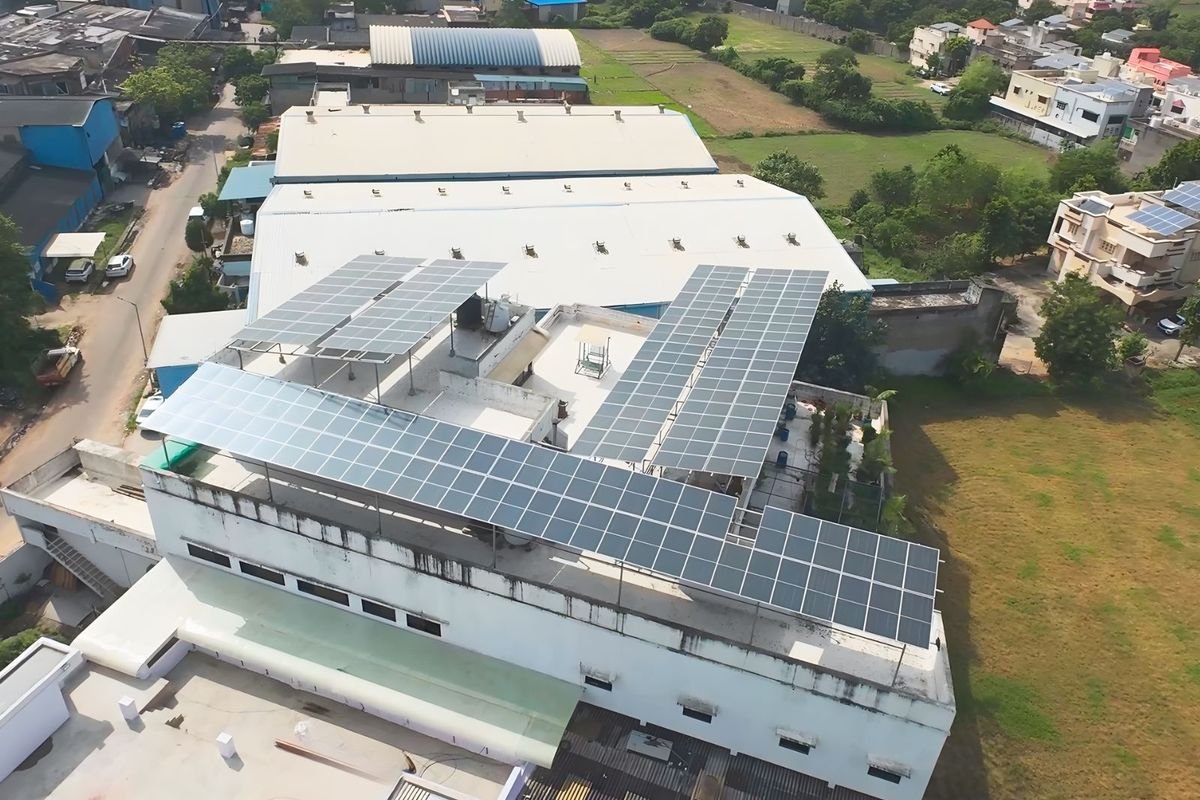
Most units in the GIDC estates around Ahmedabad have metal sheet roofs on steel frames or pre engineered buildings. Panels go on short rails clamped to the sheet ribs or fixed into the purlins below. A plant like this adds roughly 12 to 15 kg per square metre, which a healthy shed handles easily.
What we look at: sheet thickness and profile, purlin size and spacing, rust at the fixing points, old leak patches and how many years the sheet has left. If the sheets are near the end of their life, replace them before the solar goes up. Taking a plant off later to re-roof costs real money, and nobody budgets for it.
RCC roofs
Flat concrete roofs on office blocks and older buildings need an elevated structure tilted toward the south. This is also the usual setup for solar on commercial buildings like offices and hospitals. Here we check the slab, the waterproofing and the parapet height, and we plan anchoring that doesn’t wreck the waterproofing. Water tanks, lift rooms and staircase heads throw long shadows in winter, so we map those too.
The six things we check on every factory roof
- Sheet and purlin condition, including rust at fixing points.
- Years of roof life left.
- Shade from water tanks, lift rooms and taller buildings next door, mostly on winter afternoons.
- Turbo ventilators, skylights, chimneys and exhaust ducts, which cannot be covered.
- Wind load. Ahmedabad falls in the 39 m/s basic wind speed zone under IS 875 Part 3, and the structure is designed for that, with extra care at roof edges and corners.
- Safe access, walkways and fire paths, which take up more space than people expect.
And if your roof is asbestos cement, that’s a separate story. We usually advise against drilling into it at all.
How big a plant does your factory need?
Start with the bill, not the roof. Pull out 12 months of electricity bills and look at the units, not the rupees. In Gujarat, 1 kW of panels makes about 4 units a day, or roughly 125 units a month.
Then look at when you use that power. A unit running one day shift, six days a week, uses most of its solar output on the spot. That’s the best case for rooftop solar for factories, because every unit you consume directly replaces a unit you’d have bought from the grid. A unit that runs mostly at night needs a different conversation.
Roof space sets the ceiling. Plan for about 80 to 100 sq ft of shade free roof per kW, so a clear 10,000 sq ft shed can carry roughly 100 to 125 kW. Gujarat’s Renewable Energy Policy 2023 doesn’t cap rooftop capacity at your sanctioned load, but the DISCOM still approves a specific capacity for your connection, and that’s the number you’re allowed to run. For a quick first estimate from your monthly bill, try our solar savings calculator.
Worked example: a 100 kW plant for a factory in Odhav
This is an illustration with typical numbers, not a client case.
- The bill. An engineering unit in Odhav uses about 15,000 units a month on one day shift, six days a week. With fuel surcharge and electricity duty, each unit it buys costs about ₹7.50 on the variable part of the bill.
- The roof. It has a 10,000 sq ft sheet roof in decent shape and a few turbo ventilators. After walkways and shade, about 9,000 sq ft is usable. A 100 kW plant fits comfortably.
- Cost and savings. At ₹44,000 per kW, the plant costs about ₹44 lakh. It should make around 1,50,000 units a year. At ₹7.50 a unit that’s roughly ₹11.25 lakh saved a year, a little over ₹90,000 a month. Simple payback: about 3.9 years.
- Tax and loan. Solar plants qualify for 40% accelerated depreciation under the Income Tax Rules. On ₹44 lakh, that’s ₹17.6 lakh of depreciation in year one. For a company paying 25% tax, the cash benefit is about ₹4.4 lakh, which pulls payback closer to 3.5 years. Prefer a loan? A 5 year loan at 10% works out to an EMI of about ₹93,500 a month, roughly what the plant saves.
Two honest caveats. Sunday output goes to the grid and is worth less than a unit you use yourself, so real savings land a little below this. And your CA should confirm the depreciation for your books. If the plant is put to use for less than 180 days in the financial year, only half the rate is allowed that year.
Approvals and net metering in Gujarat, step by step
Most delays come from here, so it helps to know the order. Under the GERC net metering rules as amended in 2024, a rooftop project moves like this:
- Registration with GEDA, within 5 days of a complete application.
- Approval of the single line, earthing and wiring diagrams by the Chief Electrical Inspector (CEI), within 10 days.
- A technical feasibility check by the DISCOM, which looks at your load, the transformer and feeder capacity.
- The connectivity agreement. After the completion letter, the project has 6 months to finish.
- CEI charging approval, meter installation and commissioning.
The regulation even fixes compensation of at least ₹500 a day if the DISCOM misses its timelines without just cause. In our experience, though, incomplete files cause far more delay than the DISCOM does. That’s why we prepare and follow up the paperwork ourselves.
On net metering, the 2023 policy lets rooftop projects pick net or gross metering. For commercial and industrial users, banking is monthly, banking charges apply, and peak hour charges apply on consumed units, including banked ones.
Don’t install more than you were approved for
One recent case is worth knowing. On 18 September 2026, GERC dismissed a petition from a cold storage unit in Mahuva that had added an extra 10 kW inverter to a plant approved at 50 kW. PGVCL treated it as unauthorised use and raised a penalty bill of about ₹4.3 lakh, later revised to ₹1.4 lakh and paid under protest (SolarQuarter’s report). If you plan to grow, apply for the extra capacity first.
What installation looks like on a working shop floor
Industrial solar panel installation is mostly a planning job, because factories can’t stop for solar. We plan around your shifts. Material goes up to the roof in batches, the structure and panels go in section by section, and the inverter ties into your LT panel during a short planned shutdown, usually on a weekly off. Every string is tested before anything connects to the grid.
After the DISCOM inspection and meter fit, the plant goes live and we set up monitoring. From there, cleaning is the job that matters most. In dusty estates like Vatva or Naroda, a couple of skipped cleaning cycles show up plainly in the daily generation graph.
How to get an accurate installation quote for your factory
A quote is only as good as what goes into it. Send us these and we can usually tell you in one conversation whether rooftop solar fits:
- 12 months of electricity bills, all pages.
- Sanctioned load or contract demand, and whether you are on LT or HT supply.
- Roof photos from the top and from inside the shed, or the building drawings.
- Shift timings and weekly offs.
- A Google Maps pin of the unit.
A good quote should then list panel make and wattage, inverter make, structure material and coating, cable sizes, expected yearly units, who handles DISCOM and CEI approvals, warranty terms and what the AMC covers. If anything is missing, ask for it in writing.
Red flags in a factory solar quote
- One price per kW with no brands named anywhere.
- No roof visit before the quote. Nobody can price a factory roof from a satellite photo.
- A plant bigger than your connection can get approved, with a promise to “manage it” later. See the GERC case above.
- No walkways or lifelines in the layout drawing.
- Payback worked out as if every single unit is used in house, Sundays included.
- “Maintenance free” panels. They aren’t, especially next to a highway or a foundry.
When rooftop solar is not the right move
We’d rather say this before you spend anything. Rooftop solar is a poor fit if the roof has less than 5 to 7 years of life left and you aren’t ready to replace it, if it’s asbestos cement, if you rent the building on a short lease, or if most of your load runs at night. For high load units with a small or shaded roof, a ground mount solar plant on spare land can do what the roof can’t. And sometimes the honest answer is to fix the roof this year and add solar next year.
Factory solar projects we’ve done around Ahmedabad
Close to the city, we have built a 250 kWp rooftop plant for Partabi Industries in Kerala GIDC, Bavla, 100 kWp for Vijay & Kishor Engineering in Vatva GIDC, and 100 kWp on VIMS Hospital in Motera. Further out, there’s a 1,250 kWp plant for Chamunda Plastic in Kheda and 400 kWp for Sahara Granito near Himmatnagar. See the details on our projects page, or read how we work across the city on our solar company in Ahmedabad page.
If you’re comparing EPC companies, look at plants like yours, ask to speak to the owner and check how that roof looks two years on. It tells you more than any brochure. Our commercial and industrial solar page explains how we run a project from bill review to service.
Frequently asked questions
How much does a 100 kW rooftop solar plant cost for a factory in Ahmedabad?
Most 100 kW factory rooftop plants in Ahmedabad cost about ₹40 to ₹48 lakh in 2026, or ₹40,000 to ₹48,000 per kW. The exact figure depends on roof type, structure height, brands and cable distance. You get a fixed price after the site visit.
Why do 2026 solar quotes cost more than in 2024?
Module prices were unusually low in 2024. Since 1 June 2026, net metering projects must use modules with Indian cells listed under ALMM List-II, which cost more. Plants commissioned in 2024 are often on track to pay back in about 2.5 years; similar LT-connected plants in 2026 are closer to 3.5 to 4 years. HT units that save more per unit can still pay back faster.
Is there a government subsidy for factory rooftop solar in Gujarat?
No. The PM Surya Ghar subsidy covers homes and housing society common areas, not commercial or industrial plants. Factories gain through accelerated depreciation, lower power bills and the provisions of the Gujarat Renewable Energy Policy 2023.
Can solar panels go on a metal sheet factory roof?
Yes, it is the most common setup we install. Panels sit on short rails clamped to the sheet or fixed to the purlins. We check sheet thickness, purlins and rust first, and we suggest replacing old sheets before installation.
How much roof area does a factory need for solar?
Plan for about 80 to 100 sq ft of shade free roof per kW. A 100 kW plant needs roughly 8,000 to 10,000 sq ft, plus room for walkways.
How long do approval and installation take?
The GERC rules set short timelines for each step, such as 5 days for GEDA registration and 10 days for CEI drawing approval, and allow 6 months to finish after the completion letter. The physical work on a typical factory roof takes far less time than the paperwork. Complete documents are what speed things up most.
Can we take a loan for a factory solar plant?
Yes. We arrange solar loans through Solfin, Ecofy and Ratnaafin, and the lender sets the rate and eligibility. For many factories, the EMI on a 5 year loan comes close to the monthly saving.