Quick answer: In Gujarat, a 100 kW industrial rooftop solar plant costs about ₹40–48 lakh in 2026, GST included, or ₹40,000–48,000 per kW (indicative, October 2026). It makes around 1.5 lakh units a year, saves about ₹10.5–12 lakh a year at a typical industrial tariff, and pays back in about 4 years. It needs 8,000–10,000 sq ft of shade-free roof.
A 100 kW plant is the size most mid-sized factories in Gujarat end up asking about. It suits a unit with a monthly bill somewhere around ₹1 to ₹1.5 lakh, it fits on one decent shed, and it’s big enough that the price per kW starts to drop properly.
It’s also the size where quotes get confusing. You’ll see ₹38 lakh from one company and ₹50 lakh from another for the same “100 kW”. This guide breaks down the real 100 kW solar plant cost in 2026, what you save, how long it takes to pay back, and what a proper quotation should spell out. We’re ASV Energy Solutions, a solar EPC company in Koba, Gandhinagar, and 100 kW is one of the sizes we build most.
100 kW solar plant cost in Gujarat in 2026
For a grid-connected plant on a sound metal sheet or RCC roof, this is what 2026 quotes look like:
| Item | Typical range |
|---|---|
| Price per kW (turnkey, GST included) | ₹40,000 to ₹48,000 |
| Total for 100 kW | ₹40 to ₹48 lakh |
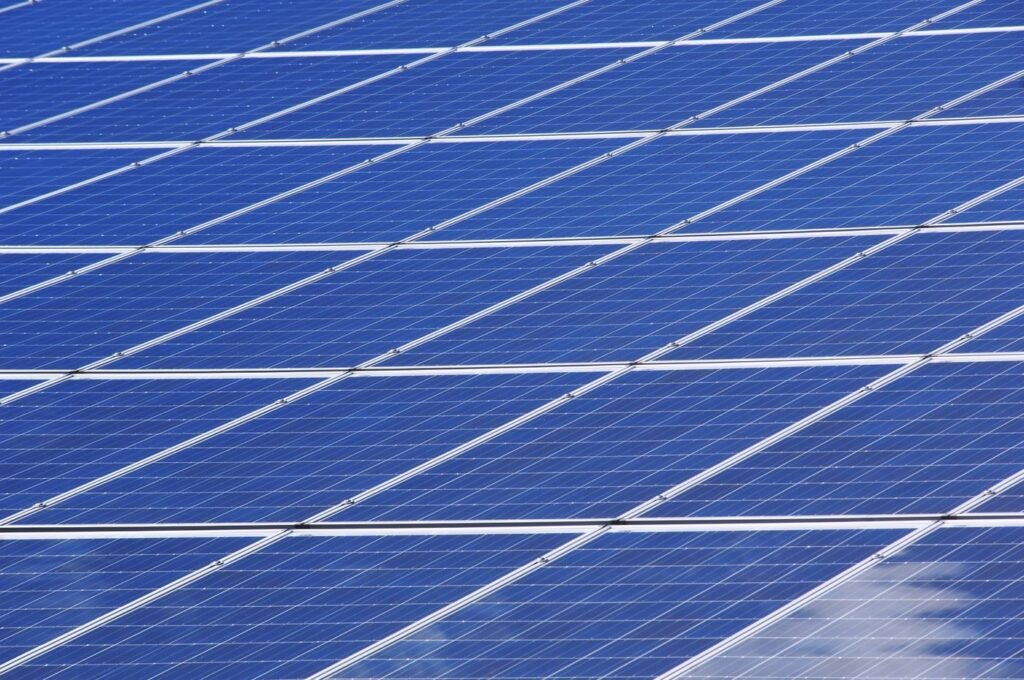
| Panels needed | About 162–172 TOPCon panels of 580–620 W |
| Shade-free roof needed | 8,000 to 10,000 sq ft |
| Units generated | About 1.5 lakh a year (around 410 a day) |
| Yearly saving at about ₹8 a unit | ₹10.5 to ₹12 lakh |
| Simple payback | About 4 years |
The ₹8 lakh spread comes from real differences, not just margins. A raised structure needs more steel than one fixed flat to the sheet. A long cable run across a big campus adds up. Premium bifacial panels cost more than standard ones. And a roof that needs sheets replaced first adds its own line. Per kW, 100 kW is noticeably cheaper than a smaller plant, because design, approvals and testing cost about the same for both. Our industrial solar cost per kW guide shows how the price changes with size.
Where the money goes
Take a ₹44 lakh plant, right in the middle of the range:
| Component | Approx. cost | Share |
|---|---|---|
| Panels (about 162–172 × 580–620 W TOPCon, ALMM listed) | ₹19.8 lakh | 45% |
| Design, approvals, installation, commissioning | ₹5.6 lakh | 13% |
| Mounting structure | ₹5.3 lakh | 12% |
| Cables, ACDB, DCDB, earthing, LA, walkways | ₹5.3 lakh | 12% |
| Inverters (one 100 kW or two 50 kW) | ₹4.4 lakh | 10% |
| GST (about 8.9% effective) | ₹3.6 lakh | 8% |
| Total | ₹44.0 lakh | 100% |
What changed in 2026 pricing
GST came down. From 22 September 2025, solar devices moved from 12% to 5% GST, as Energetica India reported. Solar EPC contracts are usually taxed on a 70:30 split, goods at 5% and services at 18%, so a full plant now carries about 8.9% effective GST instead of about 13.8%. On a 100 kW plant, that’s roughly ₹2 lakh less tax. Confirm the GST treatment of your contract with your CA.
Panels went the other way. Net-metered plants must use ALMM-listed panels, and from 1 June 2026 the approved list (ALMM List-II) covers solar cells too. MNRE has exempted net-metering projects commissioned on or before 31 December 2026 from the cell rule, but plants commissioned after that will need Indian cells, which cost more. So panel prices stayed firm, and the two changes roughly cancel out. That’s why 2026 prices look only slightly lower than early 2025.
One inverter or two?
A 100 kW plant can run on one 100 kW inverter or two 50 kW units. One inverter is a little cheaper. Two cost slightly more, but if one fails, half your plant keeps running while it’s repaired. For a factory that depends on daytime savings, we usually recommend two. Ask which one your quote assumes, because it changes both the price and the risk.
Is 100 kW the right size for your factory?
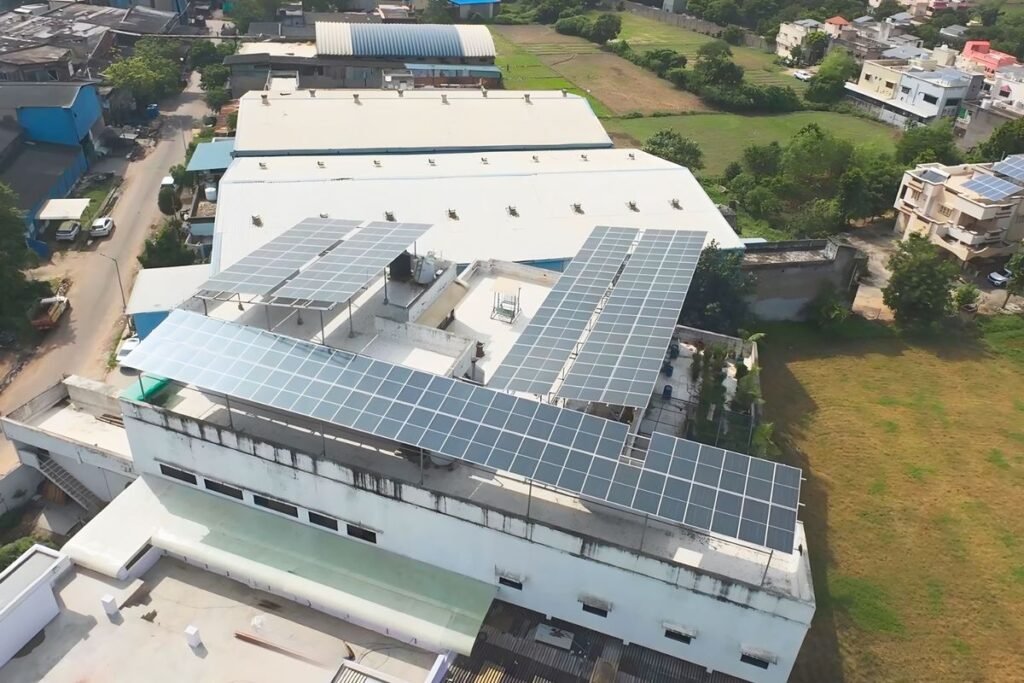
A 100 kW solar system makes about 12,500 units a month. It’s a good fit if your unit uses roughly 12,000 to 18,000 units a month, mostly in daylight hours. At Gujarat industrial rates, that’s often a bill of ₹1 to ₹1.5 lakh. Our guide to sizing factory solar from your bill walks through the maths.
- Good fit: one or one and a half shifts, six days a week, with most power used between 9 and 6.
- Roof: about 80 to 100 sq ft of shade-free roof per kW, so 8,000 to 10,000 sq ft, plus walkways.
- Bill check: if your daytime use is closer to 6,000 to 9,000 units a month, a 50 kW plant may give better value.
- Not a fit: mostly night-shift loads, or a roof with only a few years of life left.
Before anyone quotes, the roof needs a proper check: sheet thickness, purlins, rust and leak history. Our factory rooftop solar guide for Ahmedabad explains what we look at.
What a 100 kW plant generates and saves
In Gujarat, each kW of panels makes about 1,500 units a year, so 100 kW gives around 1.5 lakh units, or about 410 a day on average. Summer runs higher, monsoon lower.
At a blended industrial tariff of about ₹8 a unit, 1.5 lakh units are worth ₹12 lakh. You won’t use every unit in-house, though. Sunday and holiday output goes to the grid under net metering and is worth less. After that and a small upkeep cost, a realistic first-year saving is about ₹10.5 lakh with 85% of units used in-house. If 90% is used in-house, it’s about ₹10.9 lakh, rising toward ₹12 lakh if your plant runs seven days a week.
| Worked example | Figure |
|---|---|
| Cost (turnkey, GST included) | ₹44 lakh |
| Year-one saving (85% of 1.5 lakh units used in-house at ₹8, rest exported, minus upkeep) | About ₹10.5 lakh, or ₹87,000 a month |
| Simple payback (₹44 lakh ÷ ₹10.5 lakh) | About 4.2 years |
| With 40% accelerated depreciation at 25% tax (₹17.6 lakh × 25%) | About ₹4.4 lakh cash benefit; payback about 3.8 years |
| 25-year saving (tariffs +2% a year, panels −0.6% output a year) | About ₹3.1 crore, roughly 7 times the cost |
A real one from our list: Vijay and Kishor Engineering in Vatva GIDC, Ahmedabad, put a 100 kWp plant on their roof. Their monthly bill went from about ₹1.2 lakh to about ₹30,000. We’ve built 100 kWp plants for VIMS Hospital in Motera and St. Xavier’s College in Navrangpura too. They’re all on our projects page.
Loan or cash for a 100 kW plant?
On a ₹44 lakh plant, a 5-year loan at 10% works out to an EMI of about ₹93,500 a month. That’s slightly above the roughly ₹87,000 a month the plant saves, so you’d add a little for five years. On a 7-year loan, the EMI drops to about ₹73,000, comfortably below the saving from month one. We arrange solar loans through Solfin, Ecofy and Ratnaafin, and the lender sets the final rate and eligibility.
| Option (₹44 lakh at 10%) | Monthly EMI | vs ₹87,000 monthly saving |
|---|---|---|
| 5-year loan | About ₹93,500 | About ₹6,500 a month extra for 5 years |
| 7-year loan | About ₹73,000 | About ₹14,000 a month in hand from month one |
Cash gives the quickest payback and a clean depreciation claim. A loan keeps working capital free for the business. Both are sensible. It mostly depends on what else that ₹44 lakh could be doing. Try the industrial solar ROI calculator with your own tariff.
Approvals for a 100 kW plant in Gujarat
Under the GERC net metering regulations (as amended; GERC has also published draft regulations in 2026 that would replace them), a 100 kW plant follows these steps:
- Registration of the project with GEDA.
- Chief Electrical Inspector approval of the single-line, earthing and wiring drawings.
- A technical feasibility check by your DISCOM, covering your load, transformer and feeder.
- Connectivity agreement, installation, then CEI charging approval and meter fitting.
If the DISCOM’s network needs strengthening to take your plant, there may be a charge, and the rules differ for LT and HT connections. The DISCOM will also ask for the protection devices its norms require. Your EPC should tell you upfront which of these applies to your connection.
What your 100 kW EPC quotation should list
On a ₹44 lakh job, a ₹4 lakh difference between two quotes is common. It’s usually explained by what’s left out. A complete solar EPC quotation for 100 kW names:
- Panel brand, wattage, panel count and ALMM status (and whether the cells are Indian).
- Inverter make and model, one or two units, and the warranty.
- Structure material, coating and height.
- Cable sizes, ACDB and DCDB, earthing, lightning arrester, walkways and lifelines.
- Expected yearly units and how they were worked out.
- Who files GEDA, CEI and net metering, and who pays the fees.
- AMC scope, free service visits and remote monitoring.
- Whether the 100 kW solar plant price includes GST, and the payment stages.
Line every quote up against this list before you look at the total. Our guide on how to compare industrial solar EPC quotes goes through all 12 checks.
Frequently asked questions
What is the cost of a 100 kW solar plant in Gujarat?
About ₹40 to ₹48 lakh in 2026 for a turnkey industrial rooftop plant, GST included, or roughly ₹40,000 to ₹48,000 per kW (indicative, October 2026). Roof type, structure height, cable runs and brands decide where in that range your quote lands.
How many units does a 100 kW solar plant generate per day?
About 410 units a day on average in Gujarat, or around 1.5 lakh units a year. Summer days give more and monsoon days give less.
How much roof area does a 100 kW solar plant need?
About 8,000 to 10,000 sq ft of shade-free roof, based on 80 to 100 sq ft per kW, plus space for walkways and cleaning access.
How many panels does a 100 kW solar plant need?
About 162 to 172 panels with today’s 580–620 W TOPCon modules. Older quotes based on 545 W panels show about 184 panels for the same capacity.
What is the payback period of a 100 kW solar plant?
About 4 years at a typical industrial tariff of around ₹8 a unit. With 40% accelerated depreciation, a profit-making company can bring it closer to 3.8 years. A plant commissioned late in the financial year gets only half the depreciation rate in year one, so check the timing with your CA.
Is there a subsidy for a 100 kW industrial solar plant?
No. The PM Surya Ghar subsidy is for homes and housing society common areas. Factories benefit through lower power bills, accelerated depreciation and the reduced GST on solar devices.
What GST applies to a 100 kW solar plant?
Since 22 September 2025, solar devices carry 5% GST. EPC contracts usually follow a 70:30 split, goods at 5% and services at 18%, so the effective rate on a complete plant is about 8.9%.
What is the EMI on a 100 kW solar plant loan?
On a ₹44 lakh plant at 10%, about ₹93,500 a month over 5 years or about ₹73,000 over 7 years. The 7-year EMI is below the roughly ₹87,000 a month the plant saves.
Should a 100 kW plant use one inverter or two?
Two 50 kW inverters cost slightly more than one 100 kW unit, but if one fails, half the plant keeps running. For factories that rely on daytime savings, ASV usually recommends two.
Do 100 kW plants need Indian-made solar cells in 2026?
Net-metered plants must use ALMM-listed panels. MNRE has exempted net-metering projects commissioned on or before 31 December 2026 from the ALMM List-II cell rule. Plants commissioned after that will need panels with listed Indian cells, which cost more.
Sources
- Energetica India, Government slashes GST on renewable energy devices from 12% to 5% (4 September 2025).
- Energetica India, MNRE clarification on ALMM List-II applicability (5 August 2026).
- GERC, Draft Grid Interactive Distributed Renewable Energy Sources Regulations 2026 (May 2026).
- Heaven Green Energy, Solar accelerated depreciation: 40% vs 25% year-one (updated 7 August 2026).
- ASV Energy Solutions, project records for Vijay & Kishor Engineering, VIMS Hospital and St. Xavier’s College.
Get a fixed price for your 100 kW plant
Book a free factory solar assessment. We check your roof and bills, confirm the right size and send an itemized quote with units, savings, payback and the loan option. Call or WhatsApp +91 96626 63069.