Quick answer: To compare industrial solar EPC quotations in Gujarat fairly, don’t stop at the price per kW. Check 12 things: panel make and ALMM listing, inverter brand and warranty, mounting structure, cables and safety, the generation estimate, the payback math, approved capacity, all warranties, who handles DISCOM and CEI approvals, the AMC and monitoring, the company’s track record, and the payment terms. The cheapest quote often leaves out the items that decide 25 years of output.
You’ve asked three or four companies for a quote on your factory solar plant. Now you have three or four PDFs, each with a different price, a different capacity and a different set of promises. One is ₹10 lakh cheaper than the next. So which one do you sign?
The honest answer is that price per kW alone tells you almost nothing. An industrial solar EPC quotation can look cheap because the company left out the panels you’d actually want, the safety work a sheet roof needs, or the approvals you’ll end up chasing yourself. This guide gives you 12 checks to run before you sign, so you compare like for like.
Full disclosure: we are ASV Energy Solutions, an EPC company in Gandhinagar, and we send quotes too. So treat this as the checklist we’d want a customer to hold our own quote against. If a point here makes a quote look worse, that’s the point.
Why do two EPC quotes for the same factory look so different?
Two solar EPC companies in Gujarat can quote the same 100 kW plant and land ₹10 lakh apart. It isn’t always one cheating and one being fair. Usually they’ve quoted different things. If you want to compare solar EPC quotes properly, first know what the plant should cost: our guide on industrial solar cost per kW in Gujarat sets the baseline.
One uses budget panels and a basic inverter with a 5 year warranty. The other uses ALMM listed bifacial panels, a better inverter, a galvanized structure raised for airflow, proper walkways, and takes on the DISCOM paperwork. Same capacity on paper, very different plant on the roof. The checks below pull those differences into the open.
Checks 1 to 4: the hardware
1. Panel make, wattage and ALMM listing
The quote should name the panel brand, the exact wattage and the cell type. “540W mono PERC, Brand X” is a real spec. “High efficiency panels” is not. Ask for the ALMM listing too. The government’s Approved List of Models and Manufacturers is the panel list most grid connected and net metered projects are expected to use, and from 1 June 2026 an approved cell list (List-II) also applies, per Mercom. A panel that isn’t on the current list can stall your net metering. Make every quote state the brand, so you compare panels, not adjectives.
2. Inverter brand and warranty
The inverter is the part most likely to need replacing in 25 years, usually after 8 to 10. The quote should name the inverter make and its warranty. Standard inverter warranty is about 5 years, with paid extensions up to 10 years or more depending on the brand. A quote that hides the inverter brand is hiding the one component you’ll deal with again.
3. Mounting structure
On a factory roof the structure holds everything down through storms. The quote should say the material (hot dip galvanized steel is the usual choice), the coating thickness and whether it’s roof mounted flush or raised. Raised structures cost more but keep the roof below usable and let air move under the panels. Cheap structures rust, and a rusted structure on a sheet roof is a leak waiting to happen.
4. Cables, BOS and safety
The balance of system is where corners get cut quietly. Look for DC and AC cable sizes and make, the DCDB and ACDB, earthing and lightning arrestor, and the safety items a sheet roof needs: walkways, lifelines and a fixed access ladder. These aren’t optional on an industrial roof. A quote that leaves them out looks cheaper and isn’t.
Checks 5 to 7: the numbers
5. The generation estimate
Every quote predicts yearly units. Check the basis. A fair estimate for Gujarat is about 1,500 units per kW per year, or a performance ratio around 75 to 80%. If one quote promises far more from the same roof, ask how. Shade, dust and a hot climate all pull real output down, and a number built on a spotless lab roof won’t match your shed.
6. The payback math
A good quote shows the saving and the payback, and tells you the assumptions. Watch two things. First, the tariff used. Your real blended rate, with fuel surcharge and duty, is usually ₹8 or so a unit for industry. Second, whether the math assumes every unit is used in house. It won’t be. Sunday and holiday output goes to the grid and is worth less, so a payback built on 100% self use is too rosy. Run your own numbers with our solar savings calculator and compare. Our factory rooftop solar guide for Ahmedabad works a 100 kW payback end to end.
7. Capacity versus your approved connection
Bigger isn’t automatically better. Under Gujarat’s net metering regulations, the DISCOM approves a specific plant capacity for your connection, and that’s the capacity you’re allowed to run. In September 2026 GERC upheld a penalty of over ₹4 lakh on a Mahuva cold storage unit whose plant ran at about 60 kW against a 50 kW approval, as SolarQuarter reported. If a quote sizes a plant above what your connection can get approved, ask how they’ll handle the approval.
Want a quote you can actually compare? Send us 12 months of bills and a few roof photos. We size the plant to your daytime load, use your real tariff, and give you an itemized quote with panel make, inverter, structure, generation basis and payment stages spelled out. The site visit is free.
Checks 8 to 10: warranties, approvals and upkeep
8. Every warranty, in writing
There are four, and a quote should list all four. Panel product (material) warranty is usually 10 to 15 years. Panel performance warranty runs 25 years, typically at least 80% of rated output at year 25. Inverter warranty is about 5 years. And workmanship, the EPC’s own warranty on the installation, is usually 1 to 5 years. That last one tells you how much the company stands behind its own work.
9. Who handles DISCOM and CEI approvals
A factory plant needs GEDA registration, Chief Electrical Inspector drawing and charging approval, the DISCOM feasibility check and net metering. The quote should say clearly whether the EPC does all of this or leaves it to you. The GERC rules set short timelines for each step, but only if the file is complete. “We’ll help with paperwork” is vague. “We file and follow up GEDA, CEI and net metering” is a commitment.
10. AMC, monitoring and cleaning
After commissioning, cleaning is the job that most affects output. Check whether monitoring is included, how many free service visits you get, what the annual maintenance contract covers after the free period, and the price. For industrial solar panel installation in dusty estates, a couple of skipped cleaning cycles show up plainly in the generation graph.
Checks 11 and 12: the company and the contract
11. Track record and a real site visit
Any serious solar EPC company visits your roof before quoting. Nobody can price a factory roof from a satellite photo. Ask to see plants like yours, and ideally speak to that owner. A 2 year old plant tells you more about build quality than any brochure. When you shortlist solar EPC companies in Ahmedabad or elsewhere in Gujarat, weight the ones that climbed your roof. Look through our industrial solar projects and read about the ASV team before you decide.
12. Payment terms and what’s excluded
Read the commercial terms. A heavy advance, say 80% upfront, shifts all the risk to you. Staged payments against milestones (advance, material at site, installation, commissioning) are fairer. Also read the exclusions. Civil work, a crane, roof repairs or a transformer upgrade sitting in the fine print can turn a cheap quote into an expensive one. Check the GST line too: solar EPC contracts are usually billed under the 70:30 rule, 5% on the goods share and 18% on the services share, which works out to about 8.9% overall, as Reslink explains. A quote that shows only 5% on the full value, or 18% on everything, needs a question.
A side by side look: two quotes for the same 100 kW roof
Illustration, not a real customer case. Same factory, same 100 kW, two quotes. Quote A is ₹34.5 lakh (₹34,500 per kW). Quote B is ₹44 lakh (₹44,000 per kW). On price alone, A wins by ₹9.5 lakh.
| Quote A (₹34.5 lakh) | Quote B (₹44 lakh) | |
|---|---|---|
| Panels | Brand not named, ALMM status not confirmed | ALMM listed 540W, named brand |
| Inverter | 5 year warranty, no extension | Named make, extension quoted |
| Structure and safety | Flush, thin coating, no walkways or lifelines | Galvanized, raised, walkways and lifelines |
| Generation basis | 1,700 units per kW, every unit used in house | 1,500 units per kW, Sundays shown as exported |
| Approvals | Left to you | EPC files GEDA, CEI and net metering |
| Payment | 80% advance | Staged against milestones |
Ten years on. A’s weaker panels and harder roof access lose output, the out of warranty inverter needs work, and you spent weeks on approvals. B makes more units every year and you barely think about it. Counted properly, A’s real cost catches up with B. The ₹9.5 lakh “saving” was mostly things taken out of the quote.
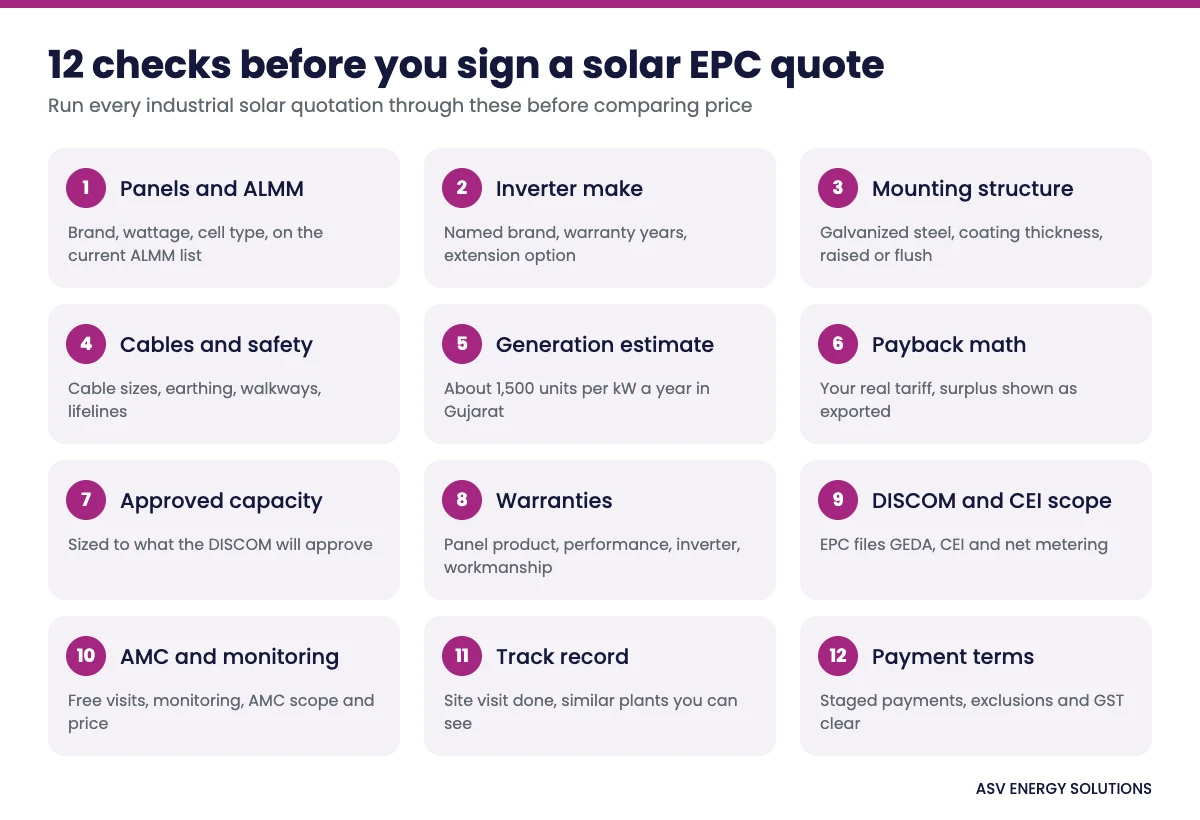
The 12 checks as a quick checklist
Print this and run every quote through it. If a column is blank, that’s your next question for the EPC.
| # | Check | What a good quote shows |
|---|---|---|
| 1 | Panels | Brand, wattage, cell type, on current ALMM list |
| 2 | Inverter | Named make, warranty years, extension option |
| 3 | Structure | Galvanized steel, coating thickness, raised or flush |
| 4 | Cables and safety | Cable sizes, earthing, LA, walkways, lifelines |
| 5 | Generation | About 1,500 units per kW, stated performance ratio |
| 6 | Payback | Your real tariff, surplus shown as exported |
| 7 | Capacity | Sized to what the DISCOM will approve |
| 8 | Warranties | Panel product, performance, inverter, workmanship |
| 9 | Approvals | EPC files GEDA, CEI and net metering |
| 10 | AMC | Free visits, monitoring, AMC scope and price |
| 11 | Track record | Site visit done, similar plants to see |
| 12 | Payment | Staged payments, exclusions and GST clear |
Red flags in a cheap industrial solar quote
- One lump sum price with no panel or inverter brand named.
- No site visit before the quote.
- Generation promised well above 1,500 units per kW with no explanation.
- Payback worked out as if every unit, Sundays included, is used in house.
- No walkways, lifelines or earthing in the layout.
- A plant bigger than your connection can get approved, with a promise to manage it later.
- A large upfront advance and vague exclusions in the fine print.
When is the lowest quote actually fine?
Cheapest isn’t always wrong. For a commercial solar or factory plant, if two quotes are genuinely like for like, same ALMM panels, same inverter and warranty, same structure and safety, same approvals and the same generation basis, then the lower price is the better deal. That’s the whole point of comparing on the 12 checks instead of the headline number. Once the quotes truly match, price is a fair tie breaker.
Accelerated depreciation applies either way. Under the Income Tax Rules, solar plants qualify for 40% depreciation in the first year (half that if the plant runs for less than 180 days in that year), which for a profit making company pulls payback in by several months. Confirm the treatment with your CA. For the full payback math, see our industrial solar ROI guide.
Frequently asked questions
What should an industrial solar EPC quotation include?
A complete quote names the panel brand, wattage and ALMM status, the inverter make and warranty, the mounting structure and coating, cable sizes and safety items, the yearly generation and its basis, all four warranties, who handles DISCOM and CEI approvals, the AMC scope, the payment schedule and the exclusions. If any of these are missing, ask before you sign.
Why is one solar quote so much cheaper than another?
Usually because the cheaper quote includes less: budget panels, a basic inverter, a thinner structure, no safety walkways, or approvals left to you. Sometimes the capacity differs too. Compare the line items, not the final price, and the gap usually explains itself.
Does the panel have to be ALMM listed for my factory?
For most grid connected and net metered projects in Gujarat, yes. The ALMM is the government approved list of panel models, and from 1 June 2026 an approved cell list (List-II) also applies. A panel that is not listed can hold up your net metering, so ask every EPC to confirm the panel is on the current list.
How many units should a 100 kW plant generate in Gujarat?
About 1,50,000 units a year, based on roughly 1,500 units per kW. A quote promising a lot more from the same roof is worth questioning, because shade, dust and heat all reduce real output.
Is a big advance payment normal for solar?
A small advance is normal, but 70 to 80% upfront puts all the risk on you. Staged payments tied to milestones, such as material at site, installation and commissioning, are fairer and more common with established EPCs.
Should I pick the EPC that quotes the largest plant?
Not automatically. The plant should match your daytime load and the capacity your DISCOM will approve. Running more than the approved capacity can bring a penalty, as a September 2026 GERC order showed. Size it right, not just big.
Do you give a written itemized quote?
Yes. After a free site visit we give a quote that lists the panel and inverter makes, the structure, generation, warranties, who handles approvals, the AMC and the payment stages, so you can compare it line by line against any other quote.
Get a quote built to be compared. We give you a clear, itemized industrial solar quote, so you can hold it against any other EPC on all 12 checks. Call or WhatsApp +91 96626 63069.