Quick answer: An industrial solar ROI calculator estimates what a factory saves on power, how long the plant takes to pay for itself, and what it returns over 25 years. For most Gujarat factories, a rooftop plant pays back in about 3 to 4 years and returns roughly 7 to 8 times its cost over 25 years. The real number depends on your tariff, how much power you use in the day, and the price per kW you pay.
Before a factory owner spends ₹40 lakh on a solar plant, one question comes first. What do I get back, and when? That’s return on investment, and for solar it’s mostly a question of math you can do on your own bills.
This guide shows you how an industrial solar ROI calculator works, what numbers it needs, and how to read the answer. We walk through a 100 kW example, show what changes the result, give you a quick calculator right here, and point you to our full solar savings calculator you can try on your own numbers.
We are ASV Energy Solutions, a solar EPC company in Gandhinagar, so we build these plants and run these numbers every week. We’ve kept the assumptions on the honest side here, because an ROI that only works on paper helps nobody.
Before you run the numbers, make sure the plant size is right. Our guide on how much solar capacity your factory needs shows how to size it from daytime units, shifts and roof space.
Industrial solar ROI calculator: try your numbers
Change the plant size, cost and your tariff to see the saving and payback. The defaults match the 100 kW worked example further down.
Estimate only. Assumes about 1,500 units per kW a year, O&M of ₹300 per kW a year, tariff rising 2% and output falling 0.6% each year. Your real numbers come after a site visit.
What ROI means for a factory solar plant
People use three numbers, and they answer different things.
- Payback period: how many years of savings it takes to recover the cost. The number most owners care about first.
- ROI over the plant’s life: total savings over 25 years, minus the cost, as a percentage or a multiple of what you spent.
- IRR (internal rate of return): a finance grade number that accounts for the timing of cash flows. Your CA can work this out from the yearly savings.
A solar power savings calculator mostly gives you the first two. Payback tells you how soon the plant stops being a cost. The 25 year figure tells you how much free power you own after that. A plant that pays back in 4 years and then runs for 20 more is, in plain terms, 20 years of nearly free electricity.
The numbers an industrial solar ROI calculator needs
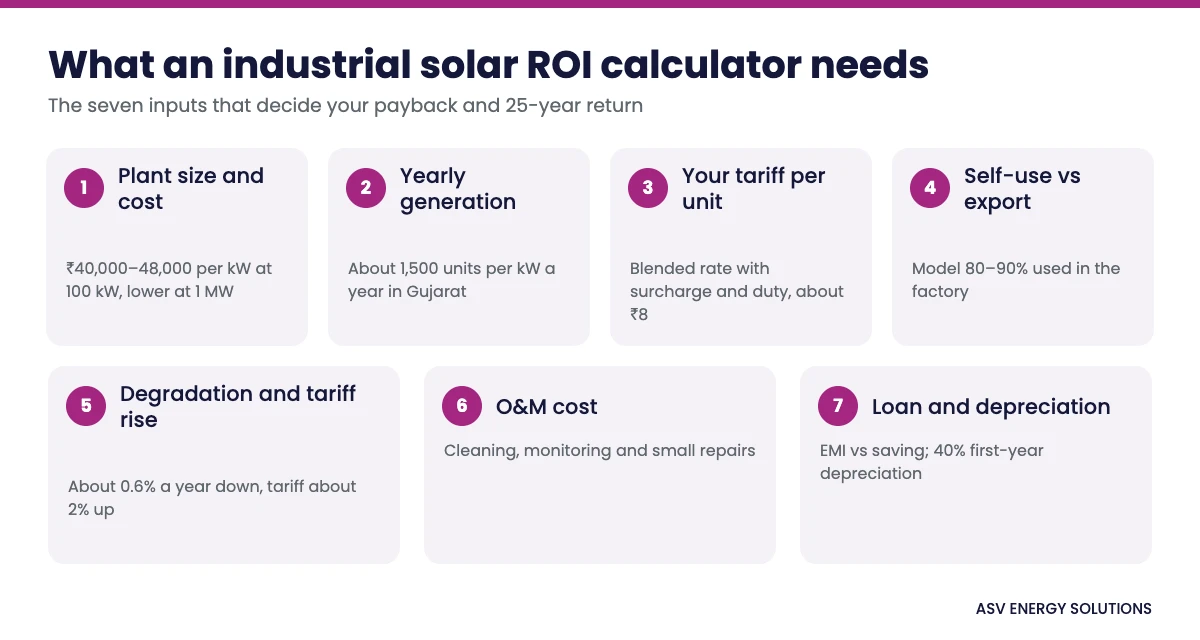
Garbage in, garbage out. The result is only as good as these seven inputs.
1. Plant size and cost
Price per kW drops as the plant grows. In 2026, factory rooftop plants in Gujarat run about ₹40,000 to ₹48,000 per kW for a 100 kW plant, down to ₹35,000 to ₹42,000 per kW at 1 MW. For the full breakdown, see our guide on industrial solar cost per kW in Gujarat.
2. Yearly generation
In Gujarat, 1 kW makes about 1,500 units a year, or roughly 4 units a day. So a 100 kW plant makes around 1,50,000 units a year. A fair calculator uses a performance ratio of about 75 to 80%, not a lab number.
3. Your tariff per unit
This is the single biggest driver, and most people get it wrong by using the “energy charge” line alone. Use your blended rate, the total bill divided by units, including fuel surcharge and electricity duty. For most Gujarat industry that’s around ₹8 a unit. A higher tariff means faster payback.
4. Self-use versus export
A unit you use on the spot saves the full tariff. A unit exported to the grid is worth less under net metering rules, set by the GERC regulations. A one shift factory uses most of its solar directly, which is the best case. A calculator that assumes 100% self use overstates the saving, so we model about 80 to 90% self use for industrial loads.
5. Degradation and tariff rise
Two slow trends pull in opposite directions. Panels lose about 0.6% of output a year, so year 25 output is lower than year 1. Grid tariffs tend to rise, often around 2% a year, which makes each saved unit worth more over time. A 25 year model should include both.
6. O&M cost
Cleaning, monitoring and the odd repair cost money. For a rooftop plant it’s small, but it’s not zero, and an honest ROI subtracts it. Plan for a modest yearly maintenance cost, higher in dusty estates.
7. Loan or own funds, and depreciation
If you buy outright, payback is the simple number. On a loan, compare the EMI to the monthly saving. And for a profit making company, accelerated depreciation is real cash back that shortens payback: under the Income Tax Rules, solar plants qualify for 40% depreciation in the first year, or half that if the plant runs for less than 180 days in that year. Confirm the treatment with your CA.
The formula, in plain terms
You don’t need a spreadsheet to sanity check a quote. Two lines do most of the work.
- Simple payback (years) = total plant cost ÷ yearly saving. A ₹44 lakh plant saving ₹11 lakh a year pays back in about 4 years.
- Lifetime ROI = (25-year savings − cost) ÷ cost. If that same plant saves about ₹3.3 crore over 25 years, the return is roughly 650%: the savings come to about 7.5 times what you spent.
For the loan case, compare the EMI to the saving. On a ₹44 lakh plant, a 5 year loan at 10% works out to an EMI of about ₹93,500 a month, or about ₹11.2 lakh a year, roughly the same as what the plant saves. Stretch the loan to 7 years and the EMI drops to about ₹73,000 a month, so the saving covers the EMI with room to spare.
Want your factory’s real ROI, not an estimate? Send us 12 months of bills and a few roof photos. We work out your plant size, yearly savings, payback and loan option on your actual tariff. The site visit is free.
Worked example: ROI for a 100 kW plant in Ahmedabad
Illustration, not a real customer case.
- The inputs. An engineering unit in Vatva runs one day shift. It uses about 15,000 units a month at a blended ₹8 a unit. Its roof fits a 100 kW plant costing about ₹44 lakh.
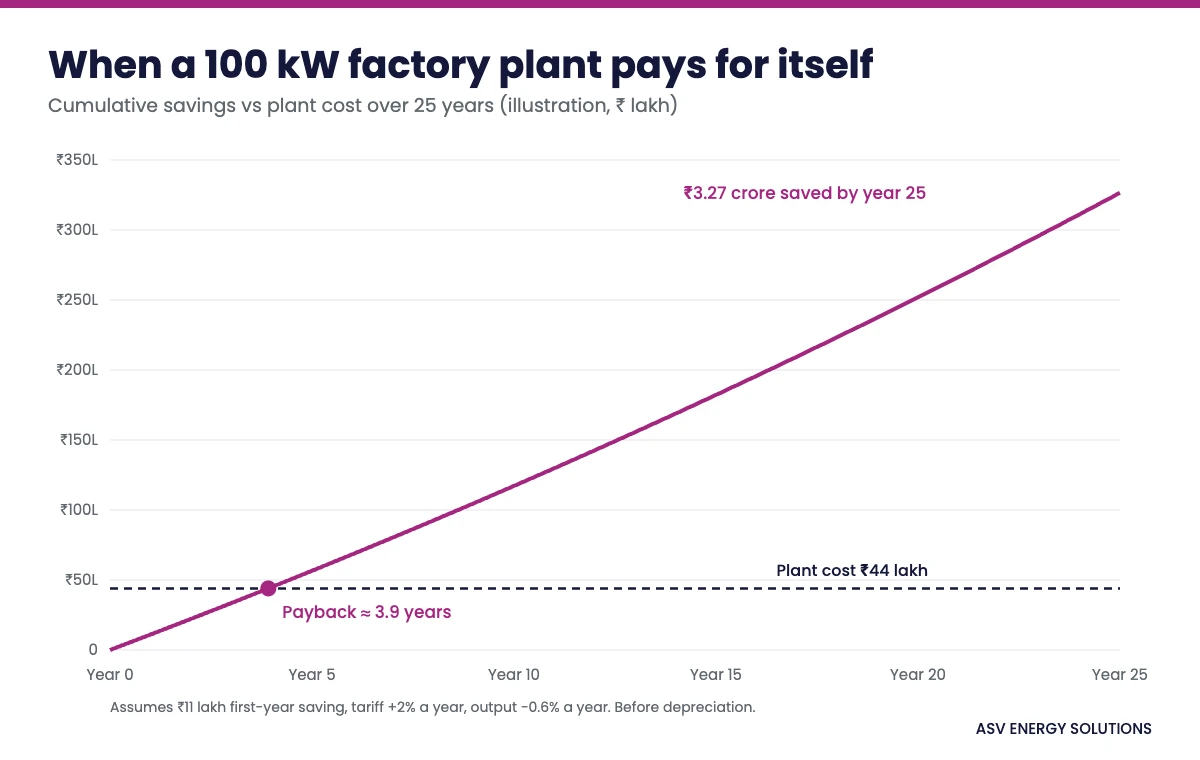
- Yearly saving. The plant makes about 1,50,000 units a year. With about 90% used in house and the rest exported, and after a small O&M cost, the first year saving is about ₹11 lakh.
- Payback. ₹44 lakh ÷ ₹11 lakh is about 4 years on simple payback. Add 40% depreciation: on ₹44 lakh that’s ₹17.6 lakh of first year depreciation, worth about ₹4.4 lakh in cash to a company at 25% tax. Net cost drops to about ₹39.6 lakh, and payback moves to roughly 3.6 years.
- The long view. With tariffs rising about 2% a year and output slipping about 0.6% a year, the plant saves roughly ₹3.3 crore over 25 years. On a ₹44 lakh spend, that’s about 7.5 times your money, and most of it lands after payback.
Want this run on your own bills? Our factory rooftop solar guide for Ahmedabad works a similar case in more detail, and the calculator does it from your monthly bill in a minute.
What changes your ROI the most
If you only check a few things, check these. They move the number more than anything else.
- Your tariff. At ₹9 a unit instead of ₹7, payback shortens by more than a year. High tariff factories get the best ROI.
- Self-use ratio. A plant whose output is used in the day beats one that exports a lot. Size the plant to your daytime load, not your total bill.
- Price per kW. Overpaying for the plant stretches payback directly. This is why comparing quotes matters; see our guide on how to compare industrial solar EPC quotes.
- Uptime and cleaning. A dirty, poorly monitored plant can lose 5 to 10% of output, which quietly adds months to payback.
- Financing. Depreciation and a sensible loan can shorten payback; a heavy upfront advance with no depreciation benefit does the opposite.
Payback and 25-year return by plant size
Larger plants cost less per kW and tend to pay back a little faster. These are indicative figures for a sound roof in Gujarat, not a quote.
| Plant size | Approx. cost | Yearly saving (year 1) | Simple payback | 25-year savings (approx.) |
|---|---|---|---|---|
| 50 kW | ₹23 lakh | ₹5.8 lakh | About 4 years | ₹1.7 crore |
| 100 kW | ₹44 lakh | ₹11 lakh | About 4 years | ₹3.3 crore |
| 250 kW | ₹1.05 crore | ₹27 lakh | About 3.9 years | ₹8 crore |
| 500 kW | ₹1.9 crore | ₹55 lakh | About 3.5 years | ₹16 crore |
| 1 MW | ₹3.8 crore | ₹1.1 crore | About 3.5 years | ₹32 crore |
The 25 year savings assume a 2% yearly tariff rise and 0.6% yearly degradation. Depreciation would pull each payback in by a few more months. Your own numbers will differ, which is the whole point of running them.
How to use our solar savings calculator
The ASV solar savings calculator gives you a first estimate from a single number, your monthly bill.
- Pick Industrial as the usage type.
- Enter your average monthly electricity bill.
- Open “Change assumptions” and set your real rate per unit, so the saving matches your bill.
- Read the recommended plant size, yearly saving, payback and the 25 year figure.
- If you plan to use a loan, check the EMI option against the monthly saving.
It uses the same assumptions as this guide: 1,500 units per kW a year, a realistic self use share, and larger plants costing less per kW.
Why a calculator is a starting point, not a quote
A solar power savings calculator is honest about one thing. It’s an estimate built on averages. Your real ROI depends on your exact roof, your shift pattern, the shade on your site and the brands in the plant. Two factories with the same bill can land a year apart on payback.
That’s why the real number comes after a site visit, not before. We check the roof, your sanctioned load and your bills, then give an itemized quote with the savings worked out on your tariff. For high load units with a small roof, a ground mount plant can change the ROI too.
Common mistakes when you work out solar ROI yourself
We see the same few errors skew people’s factory solar savings on paper, sometimes in the owner’s favour and sometimes against it.
- Using the energy charge, not the blended tariff. The real rate per unit, with surcharge and duty, is what decides the saving.
- Assuming every unit is used in house. Weekend and holiday output is exported and worth less, so the solar payback period comes out too short.
- Forgetting O&M. Cleaning and the odd repair are small but real, and leaving them out makes a commercial solar plant look better than it is.
- Ignoring depreciation. For a profit making unit, the 40% depreciation benefit is real cash that a rough calculation often misses.
- Pricing only the panels. A full industrial solar panel installation includes the structure, safety, cabling and approvals, so a cost built on panel price alone understates the spend.
Frequently asked questions
What is a good ROI for industrial solar in Gujarat?
A payback of 3 to 4 years is typical for a well built factory rooftop plant, which works out to roughly 7 to 8 times your money over 25 years. High tariff factories that use most of their power in the day do better. Overpaying for the plant or exporting a lot of power does worse.
How do I calculate solar payback for my factory?
Divide the plant cost by the yearly saving. The yearly saving is your generation times the share you use in house times your blended tariff, plus the smaller value of exported units, minus a small O and M cost. For a ₹44 lakh plant saving ₹11 lakh a year, payback is about 4 years before depreciation.
Does accelerated depreciation improve the ROI?
Yes. Under the Income Tax Rules, solar plants qualify for 40% depreciation in the first year, or half that if the plant runs for less than 180 days in that year. For a profit making company that is real cash back, usually enough to shorten payback by several months. Confirm the exact treatment with your chartered accountant.
How many units will a 100 kW plant generate?
About 1,50,000 units a year in Gujarat, based on roughly 1,500 units per kW. Shade, dust and heat can pull this down, which is why a fair calculator uses a realistic performance ratio.
Is an online solar calculator accurate?
It gives a good first estimate, but it runs on averages. Your real ROI depends on your roof, shifts, shade and the brands used. Treat the calculator as a starting point and get a site assessment before you decide.
Should I size the plant to my full bill or my daytime use?
To your daytime use. Power used on the spot saves the full tariff, while exported power is worth less under net metering. A plant sized to your working day load gives the best ROI.
Get your factory’s ROI worked out properly. We check your roof and bills and give you an itemized quote with savings, payback and the loan option on your real tariff. Call or WhatsApp +91 96626 63069.